China’s September Tungsten Ores & Concentrates Imports
In this article
Research article by Teo @ Sinamin Consulting info@sinaminconsulting.com.
Volumes down but values went the other way. Price/ton improved*.
China imported 3,663.4 tonnes of tungsten ore and concentrate in September, down 33.5% from August’s record 5,505.8 tonnes. The dollar value went the other way: RMB625 million, up 27.5%, at an average declared value of RMB170,685 a tonne.
33% less material but 25% more $. The volume number is about supply. The money number is about the tungsten content.
But, it’s worth looking at these in details as they provide some insights into the future on Tungsten pricing & the sustainability of ex-China operations.
Coincidentally, China’s Tungsten price has turned green after industry players seen the numbers. This can be explained with the reason behind it – Quota.
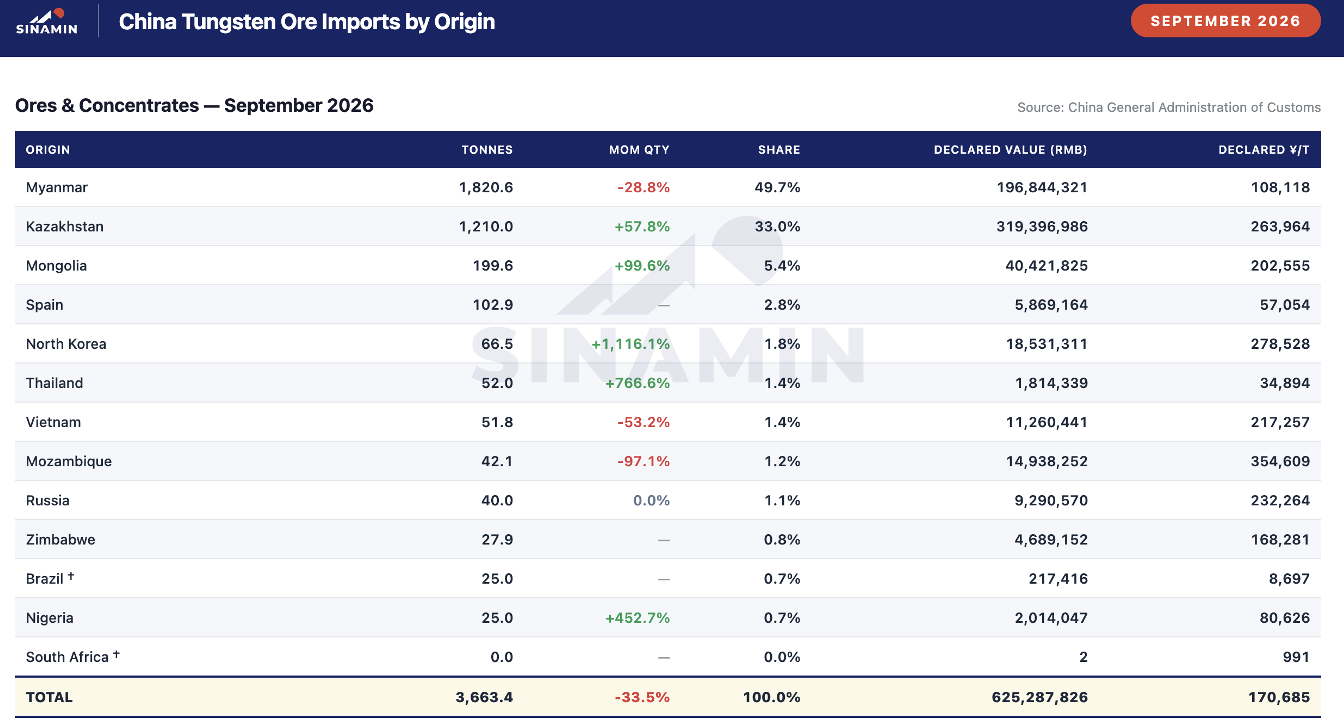
Why the value rose while the volume fell
Price September’s tonnage at August’s declared rate for each origin, and use September’s own rate only where an origin is new to this. That month clears at $21,956 a tonne. It actually cleared at $25,437. The $3,481 difference is repricing on material that was already arriving.
Where the repricing happened:
| Origin | Sept t | Sept $/t | Aug $/t | Effect on the month |
|---|---|---|---|---|
| Myanmar | 1,820.6 | 16,113 | 12,036 | +$7.4M |
| Kazakhstan | 1,210.0 | 39,339 | 36,724 | +$3.2M |
| Mozambique | 42.1 | 52,848 | 1,208 | +$2.2M |
| Mongolia | 199.6 | 30,187 | 20,989 | +$1.8M |
| Thailand | 52.0 | 5,200 | 26,910 | -$1.1M |
| Vietnam | 51.8 | 32,378 | 10,686 | +$1.1M |
| Nigeria | 25.0 | 12,016 | 55,786 | -$1.1M |
| North Korea | 66.5 | 41,509 | 52,042 | -$0.7M |
Myanmar alone accounts for $7.4 million of the $12.8 million gap, because its declared rate rose 34% in a month on 1,821 tonnes. Kazakhstan rose 7% on 1,210 tonnes. Everything else is minimal at this stage.
These may suggest 1 of the few things:
- The imported ores are higher quality eg. higher Tungsten % = higher prices
- Operations have successfully upgraded from purely low-grade ores to concentrates
- Improvement in Tungsten market
Have we reached bottom and back on the recovery phase???
Worth remembering that Tungsten price started spiking late 2025. So we’re not far from it. But obviously there were factors that will not be present now.
One of which was CMOC actively buying APT on spot market because they did not have enough APT to fulfill their contractual obligations to customers.
Two origins, 83% of the month
Myanmar at 1,820.6 tonnes and Kazakhstan at 1,210.0 tonnes.
Between them, 82.7% of everything that crossed the border in September.
This will be the common theme going forward.
Mongolia a distant third at 199.6 tonnes. Then Spain at 102.9 tonnes, appearing from almost nothing, and North Korea at 66.5.
Surprisingly, Australia has disappeared off the list. There would be 1 of the 2 reasons:
- Shipment delay
- Existing contracts to sell to China has been fully completed, so the Australian tungsten has gone ex-China
For the nine months the two leaders hold 65.9% of the imports volume, against 55.1% in the same window last year, while the number of origins grew from 21 to 32. The tail is getting longer and the head is getting heavier, which is the opposite of diversification.
Myanmar has been the wildcard in the mix and given the concentration of the volume coming from it, any disruption will see China returns to open market as a buyer of Tungsten concentrates.
Knowing how Chinese thinks, I would believe they’re still somewhat actively sourcing Tungsten concentrates anywhere they could in order to diversify the concentration risk.
The Insights
Here is where the data stops being a trade statistic and becomes something else.
China’s domestic 65% wolframite concentrate averaged RMB409,136 a standard tonne in September. A standard tonne is one tonne of 65% WO3 concentrate, which is how China quotes this market. Strip the 13% VAT that domestic quotes carry and you get RMB362,067 a tonne.
Now read the September import book against that:
| Corridor | Sept declared | vs domestic ex-VAT |
|---|---|---|
| Domestic 65% wolframite (VAT inclusive) | RMB409,136 | 113% |
| Domestic, VAT stripped | RMB362,067 | 100% |
| Mozambique | RMB354,609 | 98% |
| North Korea | RMB278,528 | 77% |
| Kazakhstan | RMB263,964 | 73% |
| Russia | RMB232,264 | 64% |
| Vietnam | RMB217,257 | 60% |
| Mongolia | RMB202,555 | 56% |
| Zimbabwe | RMB168,281 | 46% |
| Myanmar | RMB108,118 | 30% |
| Nigeria | RMB80,626 | 22% |
| Spain | RMB57,054 | 16% |
| Thailand | RMB34,894 | 10% |
| Brazil | RMB8,697 | 2% |
Some of that spread is likely grade. You can guarantee Myanmar’s materials are not sixty-five percent, and freight and treatment charges are real. But grade cannot carry this table. Kazakhstan’s ore comes from Boguty, commissioned last year and ramping up quick, shipping back to a Chinese smelter that knows for processing into APT. It declares 73% of the domestic ex-VAT benchmark. The discount on the origin that will be at 65% WO3 in the book is 27%.
For the nine months, the same pair of numbers reads the same way. Imports averaged RMB246,955 a tonne declared against a domestic benchmark of RMB593,422. That is 41.6%. September was 41.7%. Two windows, one year, one discount.
What follows may be the most interesting observation – possible smuggling activity, again. Mozambique declared 1,432.9 tonnes in August at RMB8,106 a tonne. In September, 42.1 tonnes at RMB354,609. Forty-four times the value for the same material from the same origin, 2 months apart.
Now, I would like you to put any Chinese Tungsten producer in the pit with any existing ex-China miner, or even with an integrated ex-China producer. How much cost advantage do you think China has in this instance?
It’s pretty obvious here on who’s going to win. Yet companies aren’t strategizing the fact that this scenario isn’t hypothetical. IT IS REAL.
9 Months With 3 Months To Go
| Measure | Jan–Sep 2026 | Jan–Sep 2025 | Change |
|---|---|---|---|
| Volume | 28,405.9 t | 13,482.3 t | +110.7% |
| Declared value | $1,045.5M | $179.1M | +484% |
| Declared $/t | $36,804 | $13,283 | +177% |
| Origins | 32 | 21 | +11 |
Nine months of this year and we are already 40% above the volume that was imported for the whole of 2025, which closed at 20,232.5 tonnes. The run rate through September points at roughly 38,000 tonnes for the year, and that is after a 33% monthly fall.
Four origins supplied 96% of the increase:
| Origin | 2026 t | 2025 t | Change | 2026 $/t |
|---|---|---|---|---|
| Myanmar | 10,569.2 | 3,852.6 | +6,717 | 27,147 |
| Kazakhstan | 8,140.1 | 3,582.9 | +4,557 | 56,164 |
| Vietnam | 1,618.4 | 116.7 | +1,502 | 13,846 |
| Mozambique | 1,504.0 | 0 | +1,504 | 3,966 |
The other side of that table matters as much. North Korea is down 988 tonnes, to 1,514.7, at a declared $65,345 a tonne. Australia is down 226 tonnes to 276.5, at $94,993. Russia down 258 to 209.1. Uganda down 216 to 44.4.
The near-zero club
Peru has shipped 165.6 tonnes this year and declared $102 a tonne for it. Mexico, 19.8 tonnes at $282. Pakistan, 43.2 tonnes at $732. Turkey, 62.3 tonnes at $2,336. Brazil, 159.4 tonnes at $2,805, including 25 tonnes in September declared at RMB8,697.
None of those are proper prices and should be considered as anything insightful. They are likely originated from alluvial mining which is taking advantage of the Tungsten price right now, and possibly the administrative minimum it takes to move a container through a customs gate. Taken together with Mozambique’s $3,966, that cluster is about 1,950 tonnes, 6.9% of the year’s volume, declared at an average well under $4,000 a tonne for a product whose domestic equivalent is worth RMB409,000.
Though Mozambique should be taken with consideration as Zimbabwe has been a sizeable Tungsten producer, and their ban may have created a smuggling operation routed through Mozambique.
What The September Data Tells You
China’s domestic mine output is capped by a quota that has been cut roughly 6% a year for three years, with Jiangxi and Hunan under environmental and safety enforcement. The smelters still need feed.
The import acts as the release valve and also the alternative to circumvent the quota risks, and it is now running at estimated 38,000 tonnes a year against 5,800 in 2023.
A release valve needs two things: volume, and a price the market can sustain. Volume is being found in Myanmar’s Mong Jawd, in Kazakhstan’s Boguty, in Vietnamese material before the export ban, and in a long tail of restarts from Peru to Zimbabwe. Price is being managed at the border, corridor by corridor, and the spread between the dearest and cheapest corridor in a single month is forty times.
For anyone selling concentrate outside China, this is quite important to understand, more than the quota itself. At a RMB400,000 domestic price, almost any concentrate in the world clears a margin in China, which is why 25-tonne containers now arrive from mothballed mines in Brazil, Peru, Turkey and Zimbabwe, and why the origin count went from 21 to 32 in a year. That bid is the marginal price for every small non-China producer that restarted in 2026. It is also the first thing that disappears when the domestic price goes down.
October’s Test
On 20 October, chinatungsten’s headline read: tungsten concentrates back to RMB300,000/t. Down from RMB409,136 in September and from the RMB1,050,000/t peak on 12 March.
At RMB300,000, a legitimate 65% tonne is worth about RMB265,000 ex-VAT. On September’s invoice Kazakhstan declared RMB263,964. The reason to import at a discount has narrowed to nothing on the clean route, and it has narrowed while Chinese smelters are still short of quota feed.
So October answers a question September could not. If volumes hold above 3,000 tonnes while the domestic price falls, then the pull is structural, the demand gap is doing the buying. Let’s also not forget that Kazakhstan is technically barred from selling to ex-China market as well.
If volumes fall with the price, then 2026’s record import year was a price arb dressed up as a supply strategy, and the whole map re-prices from here.
Myanmar & Kazakhstan will hold, but other countries may opt to sell into ex-China markets where they could fetch a premium. With the current price environment, it certainly is a wise business decision to sell ex-China.
Few more things I will be watching:
- Whether Mozambique volume continues
- Vietnam should disappear off the list
- Myanmar’s recovery
I remain skeptical that the September repricing is reflective of the current Chinese market. But the drop in volume has certainly lifted confidence to the Chinese Tungsten market, which we’ve seen a few days of green now after a streak of reds. Should Myanmar recovers must faster than expected, it’s likely to bring the negative sentiment back into the Chinese market once more.
Sinamin Consulting helps mining companies to solve problems by understanding their biggest competitor – China.
Email info@sinaminconsulting.com for a free strategy session.
Or read more articles on my Substack at https://teosinamin.substack.com
Teo @ Sinamin Consulting
+61 468 856 517