Rio Tinto’s $15 Million Bet on the Next Vicuña Discovery
Mogotes Metals (TSXV: MOG), Rio Tinto and the Filo Sur project
In July 2024, BHP and Lundin Mining agreed to buy Filo Corp for C$4.5 billion, or C$33 a share. The transaction completed in January 2025. At the centre of it was Filo del Sol, which Lundin describes, citing S&P Global, as the largest greenfield copper discovery in 30 years. In an industry that has spent much of the past decade talking about how few major copper discoveries are being made, that stands out.
Vicuña’s February 2026 preliminary economic assessment puts the combined Filo del Sol and Josemaria resource at 14.3 million tonnes of contained copper in Measured and Indicated, plus 32.3 million tonnes Inferred, on a 100% basis. It outlines more than 70 years of mine life and US$7.1 billion of capital for Stage 1. In June, Vicuña became Argentina’s first copper project to receive RIGI PEELP status. Lundin is talking about a final investment decision as early as the end of 2026.
When a discovery reaches that scale, the interest extends well beyond the deposit itself. Majors looking at their copper pipeline start looking along strike. In July, Rio Tinto agreed to invest USD 15 million in Mogotes Metals (TSXV: MOG) at CAD 0.70 per unit, with each unit comprising one share and half a warrant. It also secured 15 months of exclusivity over Filo Sur, immediately south of Filo del Sol, and the right to match any third-party proposal for that project.
Rio has paid for a position, access to the technical work and time to decide whether the ground is worth more. I wanted to understand what that means for Mogotes shareholders.
This is the kind of analysis we publish daily in The Drill Down. Subscribe HERE for free.
Copper has a discovery problem
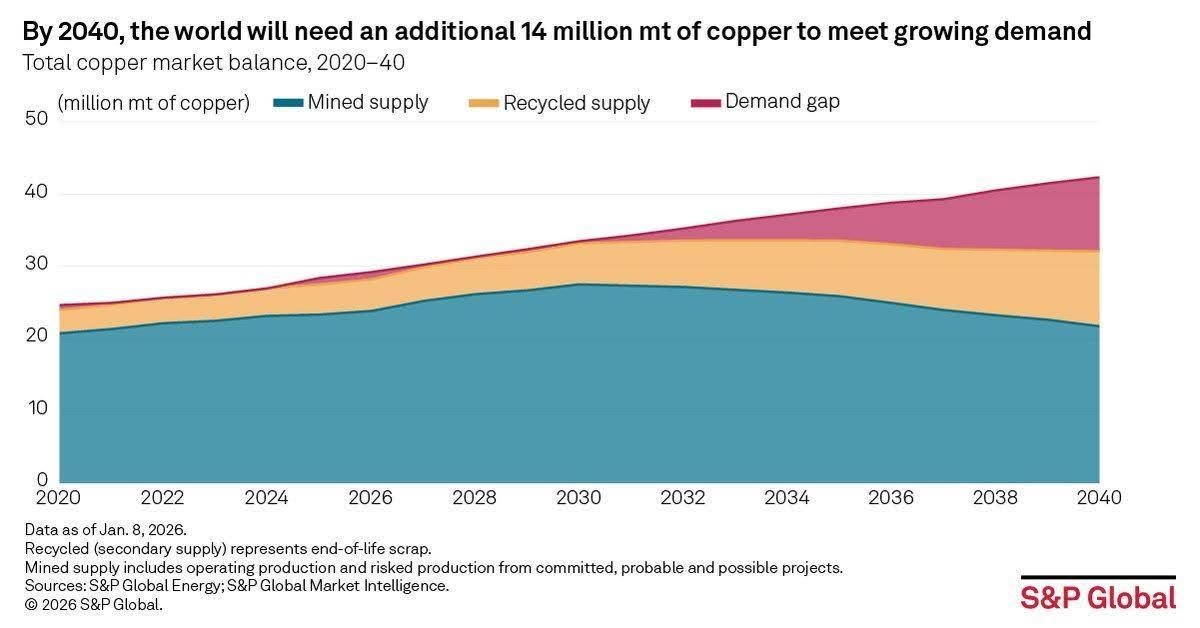
S&P Global’s January 2026 Copper in the Age of AI has demand increasing from 28 million tonnes in 2025 to 42 million tonnes by 2040. S&P’s risk-adjusted supply outlook, which includes operating mines and contributions from committed, probable and possible projects, has primary mine supply peaking at around 27 million tonnes in 2030 before falling to around 22 million tonnes in 2040. Scrap rises from 4 million tonnes to 10 million. Add the two together and you are still looking at 32 million tonnes of supply against 42 million tonnes of demand. A modelled 10-million-tonne gap.
Look at where the exploration money is going. S&P’s World Exploration Trends 2026 puts global nonferrous budgets at US$12.4 billion in 2025, down around 1%. Copper rose 2% to US$3.27 billion, its highest budget in 12 years. Grassroots exploration accounted for just 21% of nonferrous spending, a record low, while the share directed at existing mines reached 45%, a record high.
Richard Schodde of MinEx Consulting put numbers on the result at PDAC in March. New copper discoveries have roughly halved over the past decade alongside a decline of around 60% in grassroots funding. Between 2010 and 2024, work around existing mines and advanced projects delivered four times as much copper as greenfield discoveries. S&P puts the average discovery-to-production period at around 17 years. The copper required in the 2040s needs to be found well before then.
The other part of this is geology. The USGS estimates that porphyry deposits supply around 60% of global copper, and major porphyry systems often occur in clusters. For a major trying to replenish its pipeline, there is a practical choice: fund a search for an entirely new district, or secure a position beside a district where a very large system has already been demonstrated. That second route explains the interest in Vicuña’s neighbours.
Argentina rewrote the rules
Argentina spent years giving international mining investors good reasons to be cautious. Defaults, capital controls and export taxes were hardly selling points for a multi-billion-dollar copper development. The regulatory position has changed considerably since mid-2024.
The RIGI came in under Law 27.742 on 8 July 2024. Qualifying projects pay 25% income tax, against a top corporate rate of 35%, and get 30 years of fiscal stability, export duties falling to zero after three years, and a staged right to keep export proceeds offshore. PEELP status stretches the stability period to 40 years and shortens the other steps. The application window has been extended once and now closes on 8 July 2027. Separately, export duties on copper ores and concentrates were cut to zero in August 2025.
San Juan, which holds the Argentine side of Filo Sur, ranks 18th of 68 jurisdictions on the Fraser Institute’s 2025 Investment Attractiveness Index. Chile, which holds the rest of the project, ranks 32nd as a country.
Argentina is expected to elect a president on 24 October 2027. La Libertad Avanza won about 40.7% of the vote in the October 2025 midterms on provisional counts, a strong result for the government. Projects admitted to the RIGI hold stability guarantees under the law itself.
In April, Congress amended the Glacier Law to limit protection to ice bodies with a relevant hydrological function and to give the provinces more control over the inventory. La Pampa’s request to suspend the amendment was refused in May, but the underlying constitutional challenge remained open. Filo Sur’s targets sit between about 4,300 and 5,300 metres, and altitude alone doesn’t put them inside protected ice or periglacial ground.
Mining projects seeking RIGI admission must meet a minimum qualifying investment threshold of USD 200 million and other eligibility requirements. The regime improves the broader investment setting, but the reviewed disclosures do not establish that Filo Sur has been admitted or will qualify before the current application window closes on 8 July 2027. Vicuña’s August agreement with San Juan, subject to approval by the provincial legislature, caps the provincial royalty at 3% of revenue and adds a contribution of 1.5% of gross sales from the sixth year of operations, plus a US$250 million advance. New projects in provinces that adopt the 2024 federal change face a 5% ceiling, measured on mine-mouth value.
The ground south of Filo del Sol
Mogotes Metals (TSXV: MOG) is a C$280 million company at C$0.46 on 8 October, with 609.1 million shares on issue at 16 September (C$374 million fully diluted). It has C$77 million in cash, according to the capital structure slide in its latest corporate presentation. In August it raised about C$19.2 million through a rights exercise led by CD Capital, and C$26.85 million from Rio Tinto and other holders taking up their pre-emptive rights.
Filo Sur is a mix of owned and optioned ground. Mogotes owns 100% of the Argentine ground it acquired from Golden Arrow Resources, which keeps a 1.5% NSR over those properties. Mogotes can buy back 0.5 percentage points of that royalty for CAD 2 million. Mogotes also owns the Mogotes 10 property in San Juan, having exercised its option, subject to a 1.5% NSR capped at USD 200,000. It owns the Vicuña B1/B2 properties outright, subject to a 1% NSR capped at USD 500,000.
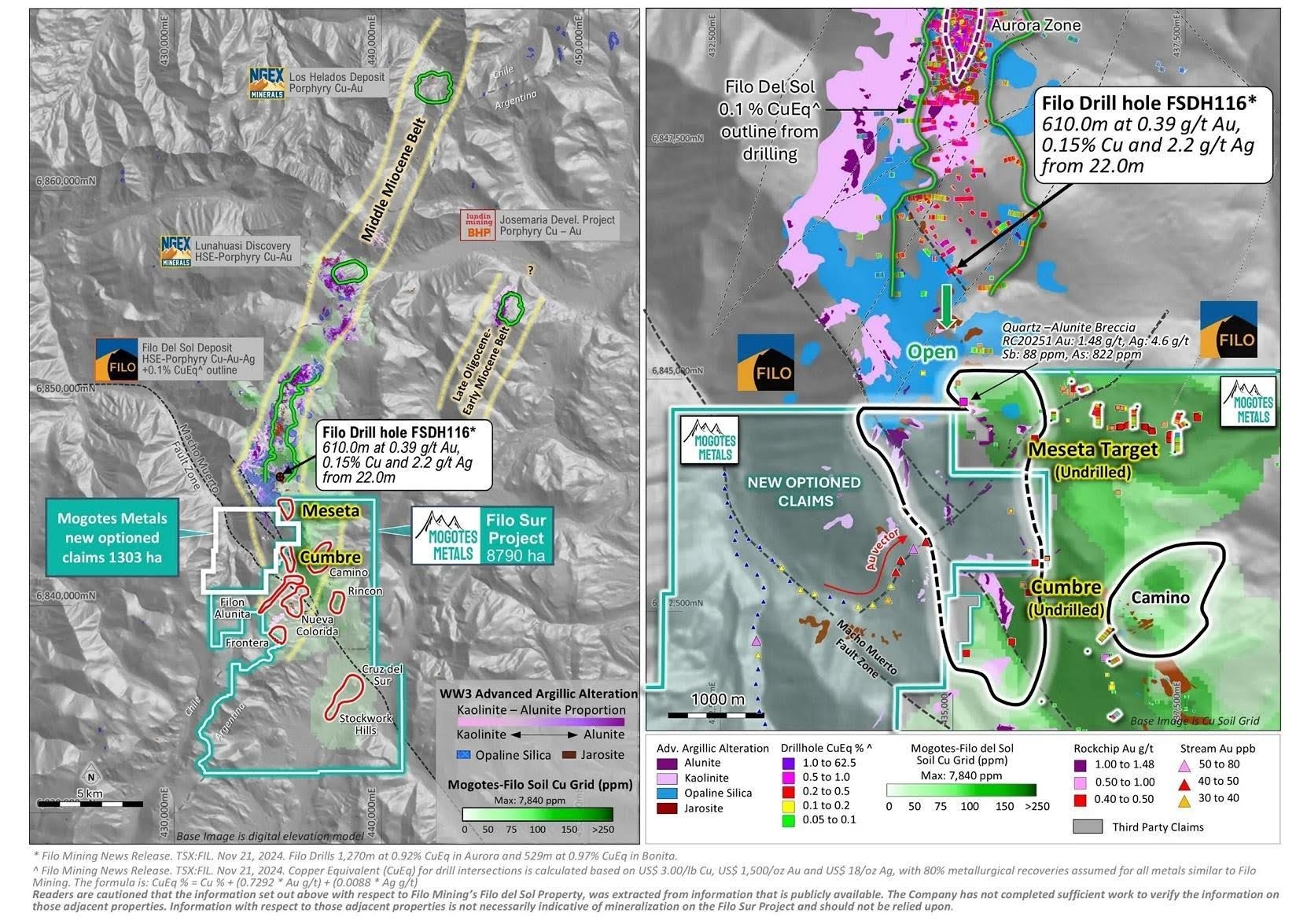
In Chile, Mogotes holds an option over 1,303 hectares of Compañía Minera del Pacífico (CMP) claims that adjoin Filo del Sol and join Filo Sur across the border. The option costs US$300,000 in cash, about 10.7 million shares issued on signing and a further US$1.0 million in shares over five years, plus spending of at least US$1.0 million a year and US$5.0 million in total. Delivering an NI 43-101 resource earns Mogotes 70% of the company holding the claims, and a PEA showing an IRR of at least 15% would add a further 10%. CMP, a Chilean iron ore producer, keeps the iron ore rights. Mogotes also holds an option over the La Perla Uno a Diez concessions, and the company puts the consolidated package at about 100 square kilometres.
The claims sit 1.2 kilometres south of Filo Corp’s hole FSDH116, which returned 610.0m @ 0.39g/t Au, 0.15% Cu and 2.2g/t Ag from 22.0m. They carry the western extensions of Mogotes’ Meseta and Cumbre targets, both undrilled when the option was signed, which gives Mogotes first drilling on the direct southern projection of the Filo del Sol trend.
At Meseta, on the boundary with Filo, reconnaissance rock chips from vuggy silica and breccias returned up to 1.48g/t Au. IP and MT surveys outlined large anomalies at both targets that continue west into the CMP ground, and Meseta is on the 2026-27 drill list.
The other two projects are on other continents. In Kazakhstan, Mogotes can buy 100% of Beskauga from Copperbelt AG for US$24.7 million, of which up to US$7.5 million can be settled in shares. US$1.0 million falls due on 1 January in each of 2027, 2028 and 2029, and the largest instalment, US$19.2 million, is due by 8 February 2029 and includes US$5.0 million that can be paid in shares. Every payment, and a minimum spend of just US$860,000, is at Mogotes’ discretion, which keeps the treasury focused on Filo Sur while Beskauga is advanced.
Beskauga was found in 2007 under up to 40 metres of clay cover, by drilling IP and magnetic anomalies through the overburden. Holes used in the 2022 estimate include:
- BG-033: 751.5m @ 0.56g/t Au, 0.25% Cu and 1.86g/t Ag from 48.5m
- BG21001: 957.0m @ 0.58g/t Au, 0.34% Cu and 1.92g/t Ag from 44m
incl. 203.0m @ 1.12g/t Au, 0.67% Cu and 3.70g/t Ag from 48m
Drilling after the estimate extended mineralisation beyond it:
- BG21007: 1,124.1m @ 0.40g/t Au, 0.25% Cu and 1.69g/t Ag from 46m
The licence also covers the Beskauga Central and Beskauga South prospects, with magnetic signatures similar to the main deposit and room for modern drilling, and the project sits 70 kilometres south-west of Pavlodar, within 20 kilometres of rail and a sealed highway.
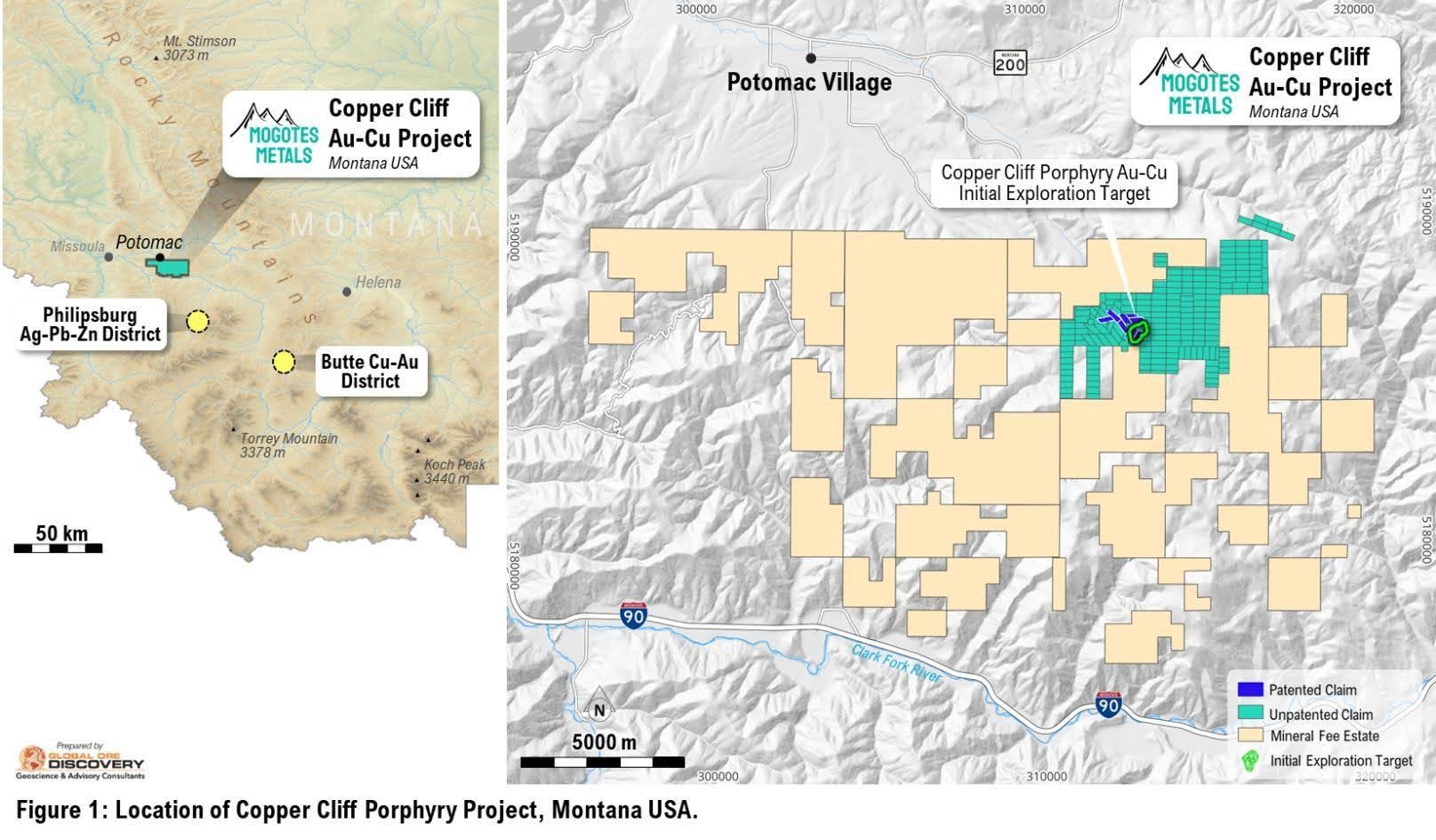
In Montana, Mogotes can earn 51% of Copper Cliff from Kennecott Exploration, a Rio Tinto subsidiary, by funding US$16 million of exploration over three years, including at least US$4.0 million in the first year, and 60% by funding US$56 million in total over six. That spending earns Mogotes its interest and creates no debt. Kennecott’s back-in rights carry a set price: within 90 days of the 51% earn-in it can pay Mogotes US$32 million to lift its share to 51%, and after the 60% earn-in it can pay US$140 million to take 60%, leaving Mogotes with 49% or 40%.
Copper Cliff covers patented and unpatented claims and fee mineral parcels in Granite and Missoula counties, 13 kilometres south-east of Potomac in the Garnet Range, over an old district mined on and off from the 1890s to the 1940s. Kennecott found the porphyry between 2006 and 2017 by drilling beneath the district’s advanced argillic alteration, and 7 of its 25 holes cut the porphyry, with hole depths from 655 to 2,019.6 metres. Grade carries deep into the system:
- 14CC0013: 1,252.5m @ 0.41g/t Au and 0.34% Cu from 665m
incl. 305.2m @ 0.67g/t Au and 0.59% Cu from 859.3m
incl. 79.8m @ 0.51g/t Au and 0.45% Cu from 1,246m
incl. 137.4m @ 0.72g/t Au and 0.51% Cu from 1,456m
Mogotes checked Kennecott’s assays against the laboratory certificates and found no inconsistencies. The ground has been idle since 2017, and Mogotes has outlined a target area about 1,000 metres deep and 450 by 300 metres in plan for step-out drilling to grow the known footprint.
At the Rio closing on 27 August, CD Capital held 14.61% of Mogotes undiluted and 18.48% on a partially diluted basis, according to the material change report. Aster Blue Ltd., an insider, held 11.74% and 16.26%. Rio Tinto holds about 5%, and it is the counterparty on two of the three projects: as the alliance partner at Filo Sur, and through Kennecott as the vendor at Copper Cliff.
What Rio bought
Rio Tinto Canada took 30,387,857 units at C$0.70, about US$15 million. Each unit carries half a warrant exercisable at C$1.00 for 18 months. The placement closed on 27 August. With the Copper Cliff option in April, this is its second transaction with Mogotes this year.
The terms around the cheque carry most of the value. Rio has 15 months of exclusivity over Filo Sur, extendable by six months if both sides agree, and during that time it can match any third-party proposal for the project or the subsidiaries that hold it. It can top up to 9.99% on a partially diluted basis, at the greater of the 20-day VWAP and a 20% premium to the last close. It has pre-emptive rights, and it sits on a joint technical committee that advises on the exploration programme. In return it accepted standstill restrictions for the exclusivity period.
I wrote about Kincora last month, where the majors fund drilling in exchange for project interests. Rio’s approach with Mogotes is different. The US$15 million gives it an equity position and a first look at the Filo Sur data, while the technical committee gives it a seat in the discussion over the next programme. The matching right means it can respond if another party tries to transact on the project. On the announced terms, Mogotes keeps control of the programme.
Funding the season
Cash now stands at C$77 million. The last filed balance sheet, at 31 May, showed cash of C$43.8 million and working capital of C$41.3 million, before the August raises added roughly C$46 million gross. In the six months to 31 May, Mogotes spent C$19.8 million on exploration and evaluation, including C$12.5 million in the second quarter.
The warrants could provide additional funding if holders choose to exercise them. At 16 September there were 53.1 million warrants at C$0.30 expiring on 31 January 2027, and 55.1 million at C$0.40 expiring in June and July 2027. Both sets are in the money at C$0.46, and full exercise would bring in about C$15.9 million and C$22.0 million.
In my view, the August raises fund the 2026-27 field season. The August-quarter accounts, due around 30 October, will show the updated balance sheet.
What the drilling has found
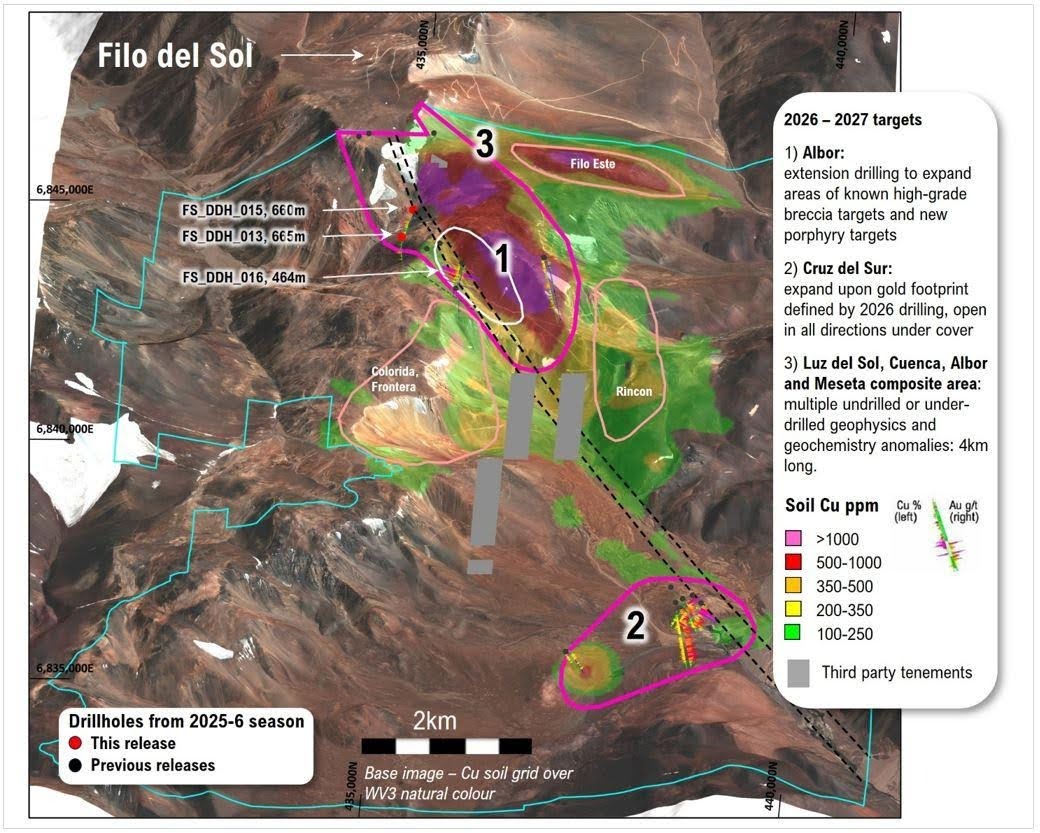
Filo Sur has been drilled before, the 2024 technical report records 4,052.4 metres drilled in 2004 and 2005, and 8,348.5 metres in 17 holes drilled by Vale in 2012 and 2013, of which 7,980.1 metres fall inside the current Mogotes claims. Mogotes drilled 3 holes for 2,185 metres in 2024, then 6,208 metres across Argentina and Chile in the 2025-26 season. That season produced two discoveries, Albor and Cruz del Sur, along the Macho Muerto Fault Zone, a structure the company traces for about 10 kilometres within the project.
Albor sits immediately south of, and along strike from, Filo del Sol, under a molybdenum-in-soil anomaly of about 400 by 800 metres.
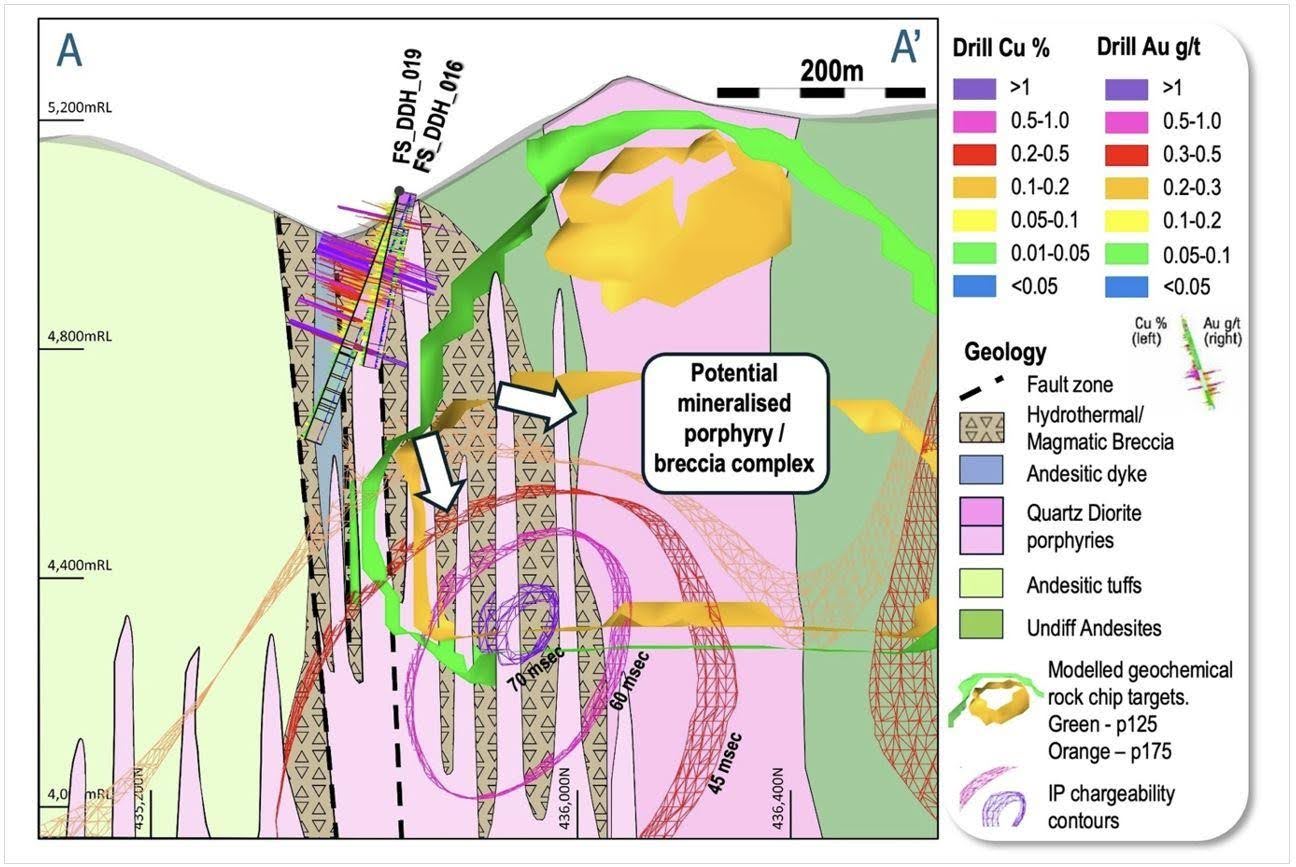
- FS_DDH_016: 180.0m @ 0.98% CuEq from 108.0m (0.51% Cu, 0.37g/t Au, 2.8g/t Ag, 119ppm Mo)
incl. 58.0m @ 1.77% CuEq from 111.0m
incl. 9.0m @ 2.84% CuEq from 276.0m - FS_DDH_019: 14.0m @ 0.82% CuEq from 48.0m (the company does not consider the hole an adequate test of the breccia)
The company reports stronger potassic alteration at depth and interprets this as evidence of a porphyry system below the breccia. The 2026-27 programme includes offset drilling at Albor.
Cruz del Sur lies 7 kilometres south-east along the same structure. It is a gold-zinc breccia sitting above a gold-copper porphyry, inside a geophysical footprint of 4.0 by 0.5 kilometres. The results below for FS_DDH_006 and FS_DDH_007 are the company’s September restatement on a CuEq basis.
- FS_DDH_005: 66m @ 0.44g/t Au and 0.27% Zn from 64m (reported in May, before the move to CuEq composites)
- FS_DDH_006: 308.0m @ 0.46% CuEq from 108.0m (0.07% Cu, 0.35g/t Au)
incl. 22.0m @ 1.00% CuEq from 192.0m
and 334.0m @ 0.45% CuEq from 456.0m (0.10% Cu, 0.32g/t Au) - FS_DDH_007: 124.0m @ 0.61% CuEq from 24.0m (0.02% Cu, 0.51g/t Au)
incl. 14.0m @ 1.48% CuEq from 108.0m
and 116.0m @ 0.31% CuEq from 174.0m
Cruz del Sur is gold-led near surface, and Mogotes interprets copper grades as improving at depth towards the porphyry.
Luz del Sol intersected copper mineralisation in its early holes:
- FS_DDH_013: 18.0m @ 0.21% Cu from 216.0m
- FS_DDH_015: 24.0m @ 0.16% Cu from 179.0m
and 20.5m @ 0.15% Cu from 218.5m
The focus has now moved to an untested IP chargeability anomaly beside and beneath those holes.
Cuenca has never been drilled. Channel sampling of four road-cut segments spread over 297 metres returned 153m @ 0.31g/t Au and 0.11% Cu of exposed rock, on a target the company now puts at 1.3 by 0.5 kilometres.
Mogotes plans up to 20,000 metres of drilling in the 2026-27 programme, more than three times last season’s total, with a November restart targeted subject to weather and site access. The company plans to offset Albor, follow up Cruz del Sur, put the first holes into Cuenca, test Luz del Sol and Meseta, and run reconnaissance along the fault zone.
Kazakhstan and Montana
Beskauga, in Pavlodar Province, is the most advanced of the three projects. A 2022 historical mineral resource estimate prepared for Arras Minerals reported 111.2Mt @ 0.30% Cu, 0.49g/t Au and 1.34g/t Ag in the Indicated category, and 92.6Mt @ 0.24% Cu, 0.50g/t Au and 1.14g/t Ag in the Inferred category. Mogotes has not completed sufficient work to classify this as a current mineral resource and is not treating it as one.
A further 18,657 metres in 28 holes were drilled after that estimate. A programme of up to 50,000 metres is under way, and the company is targeting first assays this quarter and a preliminary economic assessment within 12 months of September. Mogotes’ release on the Rio deal said the parties intend to explore extending the alliance concept to additional mineral belts, including Kazakhstan. It did not announce an agreement covering Beskauga.
Copper Cliff, in Montana, comes with Kennecott’s drilling: 25 holes for 32,000 metres between 2006 and 2017. Mogotes plans 8,000 to 9,000 metres, with drilling set to start as early as November once permits are in hand.
Both projects have already been drilled. They also broaden Mogotes’ exploration calendar and provide further opportunities for discovery outside the Vicuña district, although drilling remains subject to seasonal conditions and permits.
What this season will show
Offset drilling at Albor will show how far the mineralisation in FS_DDH_016 extends.
At Cruz del Sur, deeper holes test the company’s interpretation that copper grades improve towards the porphyry.
Beskauga’s first assays and PEA, and the start of drilling at Copper Cliff, add news flow from outside Argentina while Filo Sur is being drilled.
Rio’s matching right shows a major is engaged, and what Rio does when exclusivity ends will be the clearest signal of how it values the ground.
Who is running it
Carmel Daniele joined the board on 10 March 2026 as CD Capital’s nominee. CD Capital says it sold its Filo shares in January 2023 for C$158.3 million, and it is now Mogotes’ largest disclosed holder at 14.61% undiluted. She sat on the Filo board from 1 September 2020 and was re-elected in June 2024, a month before BHP and Lundin announced the takeover. She was on the Filo board while the majors were working out what this district was worth.
Peter Mullens, the chairman, has worked in Argentina since the mid-1990s, after senior roles at Mount Isa Mines. Mogotes lists him as a former chief geologist of Aquiline Resources, which Pan American Silver bought in an offer announced in 2009 at about C$626 million.
Allen Sabet has been president and chief executive since 2022. Between January and August 2026 he brought in CD Capital, the Beskauga option, Copper Cliff and Rio Tinto: four transactions in eight months.
What does C$280 million buy?
At a market cap of roughly C$280 million, investors are paying for Filo Sur’s location, the two discoveries reported last season, Rio’s involvement and the option value of Beskauga and Copper Cliff.
Inside that sits a 180-metre Albor intersection grading 0.98% CuEq, district-scale exploration ground in Argentina and Chile, a large historical estimate at Beskauga with drilling under way, and an earn-in on a Rio-discovered porphyry in Montana.
Dates that matter
- Third-quarter financial statements, period to 31 August 2026: due by about 30 October 2026
- Filo Sur drilling restart: November 2026 target, subject to weather and site access (company, 22 September 2026)
- Copper Cliff drilling: earliest possible start in November 2026, subject to permits (company, 22 September 2026)
- Beskauga first assays: fourth quarter 2026, company target (22 September 2026)
- Vicuña Stage 1 investment decision: “as early as year-end 2026” (Lundin, October 2026 presentation)
- Beskauga US$1.0 million option payment and mining licence application: 1 January 2027
- RIGI application window closes: 8 July 2027
- Beskauga preliminary economic assessment: within 12 months of September 2026, company target
- Argentine presidential election: expected 24 October 2027
- Rio Tinto exclusivity period: 15 months, extendable by six months
Where I land
Mogotes holds ground south of Filo del Sol, in one of the most closely watched new copper districts in the world, along a fault zone the company traces for about 10 kilometres within the project. Argentina has improved the terms for large-scale mining investment. Rio Tinto has spent US$15 million on equity, a technical committee seat and a period of exclusivity.
For me the key result this season is the offset drilling around FS_DDH_016. Good offsets and deeper intersections would start to demonstrate continuity at Albor.
Beskauga and Copper Cliff add further sources of value. Rio has bought the time to look. Mogotes is targeting a November restart for a 2026-27 programme of up to 20,000 metres, subject to weather and site access.
This analysis is from The Drill Down, a daily briefing on critical minerals, junior mining, and capital markets. Join 3,300+ investors and operators who read it before the market opens. Subscribe HERE.
Disclosure
Kamoa Capital has a commercial relationship with Mogotes Metals Inc. This article is general in nature and does not constitute personal financial advice. Readers should conduct their own due diligence and consult a licensed financial adviser before making any investment decisions. This article contains forward-looking statements based on current expectations and assumptions that are subject to risks and uncertainties. Past performance is not a reliable indicator of future performance. Readers should refer to Mogotes’ financial statements on SEDAR+ for its full financial position.
The Beskauga figures are a historical estimate prepared in 2022 for Arras Minerals Corp. Mogotes’ Qualified Person has not done sufficient work to classify the historical estimate as a current mineral resource or mineral reserve under NI 43-101 and CIM Definition Standards. The company is not treating it as current, and it should not be relied on. Copper equivalent grades are calculated by Mogotes using US$4.69/lb Cu, US$3,321/oz Au, US$38.30/oz Ag, US$22.59/lb Mo and US$1.30/lb Zn, with assumed recoveries of 80% for each metal based on district analogues. No metallurgical testwork has been done at Filo Sur. All drill intercepts are downhole lengths, and true widths are not known. Channel samples are surface samples and are not necessarily representative of mineralisation at depth, and the Cuenca channel samples were not continuous because of gaps in outcrop. Rock chip samples are selective by nature and are not necessarily representative of mineralisation on the property. A geophysical anomaly is not a Mineral Resource, and there is no certainty that drilling will define mineralisation. Copper Cliff results are historical drilling by Kennecott Exploration, and Mogotes’ verification of that data is ongoing. Mogotes’ Qualified Person has not verified the information on adjacent properties, and mineralisation on adjacent properties, including Filo del Sol, is not necessarily indicative of mineralisation at Filo Sur or the CMP claims. Vicuña figures are from a preliminary economic assessment that includes Inferred Mineral Resources.