The Shield Nobody Drilled
Sierra Nevada Gold (ASX: SNX) and Saudi Arabia’s As Safra copper discovery
I made my first trip to the Kingdom in January and it changed my picture of Saudi mining entirely. I had followed the policy announcements, the capital commitments and the exploration targets for a few years before that, so I went over thinking I had a reasonable handle on where Saudi Arabia copper exploration was up to, and within a couple of days I realised I didn’t.
Most of the commentary back home still treats Saudi mining as an ambition, something that might happen if enough things go right, but what I found was a system that has already been built and is already running. The gap between how the Kingdom gets described here and what is actually on the ground is the widest I have come across in any jurisdiction.
What stuck with me most was that the people writing mining regulation over there have worked inside mining companies, which sounds like a small point until you compare it with home. In most Western jurisdictions there is a real disconnect between the people making the rules and the people who have to live under them, and you feel it in every permitting timeline. In Riyadh I was sitting across from officials who understood what a drill programme costs and what a six month delay does to one.
The other thing was the technology, because they are building the digital architecture in from the outset rather than retrofitting it later, with geological databases, remote sensing and AI assisted targeting all treated as core inputs rather than something you bolt on in 2035. In an industry that loves being second and hates being first, I found that refreshing.
I came back a fan of what they are doing, so this is where I think it goes, and why I’ve spent time on Sierra Nevada Gold (ASX: SNX), which is the only ASX-listed company that owns 100% of a Saudi exploration project and operates it.
This is the kind of analysis we publish daily in The Drill Down. Subscribe HERE for free.
Where Saudi Arabia copper exploration actually happens
I wrote back in January that the Arabian Shield and the Yilgarn are near twins on scale. Roughly 600,000km² against roughly 650,000km². Different ages, but both carry VMS copper-zinc and orogenic gold, and the Shield also shows real porphyry copper-gold potential.
What separates them is a century of drilling on one and almost none on the other. The Yilgarn’s Eastern Goldfields Superterrane on its own holds more than 270 Moz of gold endowment. The entire Arabian Shield produces about 500koz.
Large parts of it have never been looked at with modern geophysics or modern mineral systems thinking. The French survey, BRGM, mapped and drilled a lot of it between the 1960s and 2000, and then everyone went home. The rocks were never the problem, the data just sat in a national archive for 25 years waiting for somebody to come back for it.
That is changing fast. The Kingdom has put roughly US$347 million into its Regional Geosciences Program, more than the United States, Australia or Canada spent on their equivalent programmes over comparable windows, and every bit of it is free on the National Geological Database. Minesite exploration budgets went from US$21 million in 2022 to US$146 million in 2025, a 595% jump against a global average of 6 to 8% a year. Projects drilled went from 58 in 2023 to 160 in 2024.
For an explorer that combination is rare, because first order geological risk and targeting cost both come down while you keep all of the frontier upside.
Where the ground actually moves
Round 8 handed out the Jabal Sayid and Al-Hajjar belts, 4,788km², in November 2025. Round 9 was the biggest the Kingdom has run, more than 24,000km² offered and 14,541km² awarded to 24 winners across 172 sites, with SAR 671 million of committed work over the first two years. Juniors took 69% of it, and one of the 24 winners was Sierra Nevada Gold, a sub-A$40 million ASX junior on its first attempt in country.
Round 10 qualified 24 bidders in June over roughly 13,000km², extending the same belts. Bidding is open and nobody knows the winners yet. Round 11 pre-qualification covers eight sites for 1,878km². Across 2026 and 2027 the Ministry has flagged seventeen belts spanning about 68,000km².
Every one of those awards takes ground off the table permanently, and that is where the clock on this story sits.
The bits that bother people
Bumps exist and I have gone looking for them. The regime is only six years old and has not been through a downturn or a serious dispute. No foreign-owned discovery has been carried all the way to production under it yet, which is the one thing that would settle the argument for good. Exit is thin, Manara has done one major deal in three years. Water, power and technical workforce depth are real constraints, and the Ministry itself says infrastructure can run past 25% of project capex.
The wider constraint on copper is financeability rather than capital availability, and jurisdiction sits at the centre of that. None of the above is disqualifying and all of it is priceable. Given the policy support and the capital going in behind it, I think most of it gets solved.
Why copper, and why now
S&P Global put out Copper in the Age of AI in January. Demand goes from 28 million tonnes in 2025 to 42 million by 2040. Primary mine supply peaks at 33 million tonnes in 2030 and rolls over. Scrap more than doubles to 10 million tonnes and still does not close the gap, which leaves a 10 million tonne hole by 2040.
Balance forecasts move more than people assume, and the ICSG swung 246,000 tonnes from deficit to surplus in a single revision, so treat any one projection as a direction rather than a number.
It takes about 17 years to get a copper mine from discovery to production, so anything not already found is not going to help the 2030s. The IEA has the same shape on it, a 30% copper supply shortfall by 2035.
Closer to home for the Kingdom, Saudi base metals capacity sits near 70 kilotonnes a year against giga-project copper demand estimated near 700 kilotonnes by 2040. They are short their own copper by an order of magnitude, and Jabal Sayid already proves Saudi concentrate has a working export route to third-party smelters.
Which brings me to Sierra Nevada Gold
Sierra Nevada Gold (ASX: SNX) is a A$41.76 million company at A$0.088.
It won the As Safra project in Round 9, the biggest and most contested round the Kingdom has run. 26 qualified companies bid, 24 came away with something, and the winners list includes Barrick, Ma’aden and Ivanhoe Electric. A sub-A$40 million ASX junior walking 375km² out of that room, first time in country, is the part of this story I do not think anyone has properly priced.
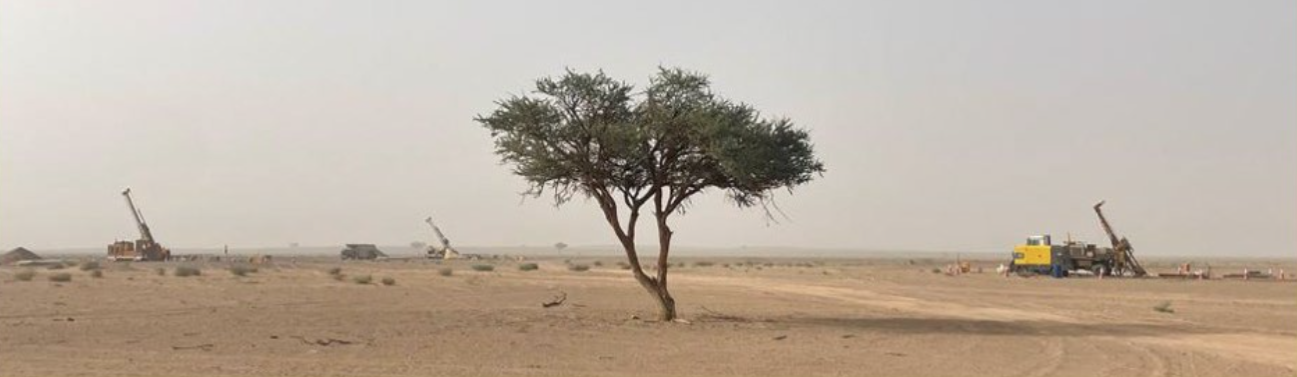
Five exploration licences followed, granted by Royal Decree effective 30 April 2026. Royal Decree is the highest tier of sovereign approval in Saudi Arabia, so ground held on that basis does not get quietly reinterpreted by the next director-general. Three rigs were turning within hours of the grant, which is quick for a first-time entrant anywhere.
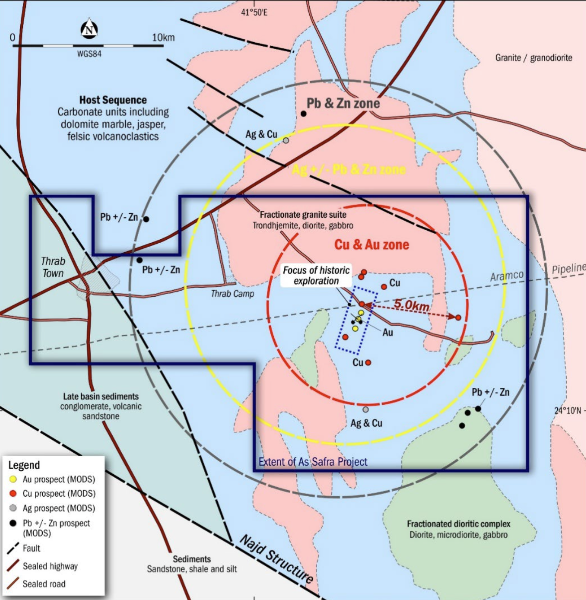
As Safra sits in Al Madinah Province, roughly 106km from the producing Jabal Sayid copper mine, held 100% and operated through SNX’s wholly owned Saudi subsidiary Arabian American Minerals (AAM).
Alara Resources holds Saudi ground through joint ventures. Resource Minerals International holds 50% of Shaib Marqan, Metal Bank holds 60% of Wadi al Junah, and Magnum Mining and European Lithium are downstream processing rather than exploration.
I went through the whole ASX register looking for a second company that owns 100% of a Saudi exploration project and operates it, and there isn’t one.
What the first drilling found
Phase 1 was 28 holes for 5,400 metres, finished in early July. Assays are out on the first four.
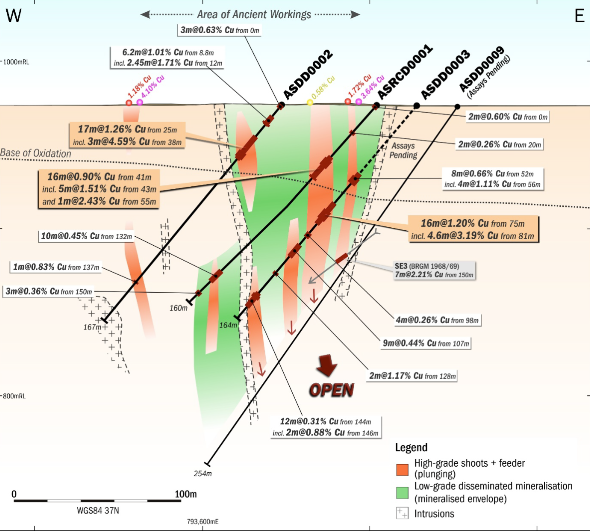
- ASDD0002: 3m at 0.63% Cu from surface, 6.2m at 1.01% Cu from 8.8m, and 17m at 1.26% Cu, 0.06 g/t Au and 7.77 g/t Ag from 25m, including 3m at 4.59% Cu and 27.34 g/t Ag from 38m
- ASDD0003: 16m at 1.20% Cu, 0.02 g/t Au and 3.30 g/t Ag from 75m, including 4.6m at 3.19% Cu from 81m
- ASDD0001: 9m at 0.91% Cu from 115m, and 13m at 0.93% Cu, 0.01 g/t Au and 4.83 g/t Ag from 211m, including 5m at 1.77% Cu from 214m
- ASRCD0001: 2m at 0.60% Cu from surface, and 16m at 0.90% Cu from 41m, including 5m at 1.51% Cu from 43m and 1m at 2.43% Cu from 55m
Copper is from surface to more than 200 metres vertical and stays open along strike and down dip. Gold at the Central target runs at trace levels, which is what you would expect from the copper-dominant core of a zoned skarn.
All of that came from roughly 400 metres of a corridor the company puts at 5.5km by 0.6km. Less than a quarter of the trend has been drilled.
The mineralogy is textbook skarn, garnet and magnetite and wollastonite where intrusions met reactive carbonate, with bismuth-tellurium associations pointing back toward sulphide-rich feeders. Ground magnetics and gravity are done and in validation, with IP running. Old IP anomalies line up with previously drilled high-grade copper and plenty of them have never been tested.
The historical dataset is why this ground was competitive in the tender and why drilling could start on day one. BRGM hit 24.55m at 1.69% Cu and 5m at 4.07% Cu. Historical rock chips run to 244 g/t gold and 11% copper.
The target nobody has drilled
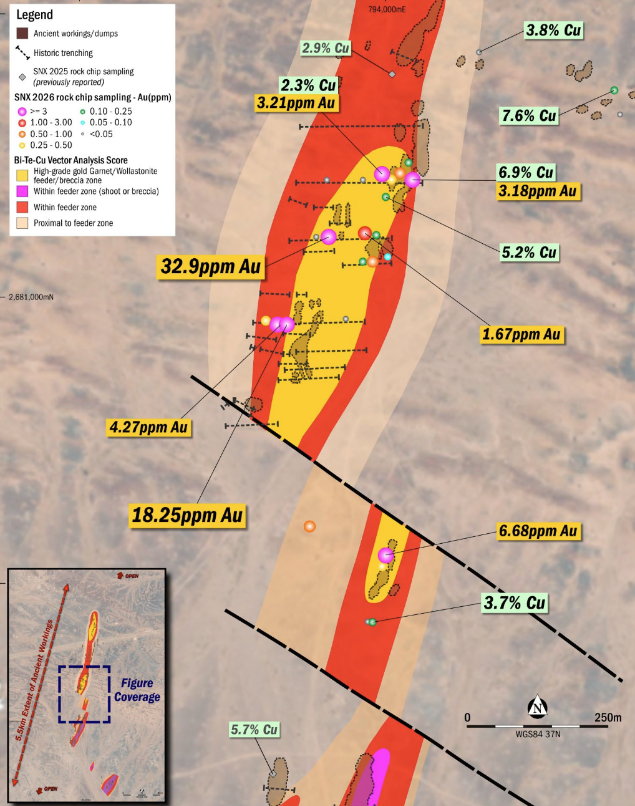
Central Copper is one target on that corridor. The Central Gold Zone is a separate high-grade gold trend of roughly 400 metres, where company rock chips have come back up to 32.9 g/t gold and historical BRGM chips ran to 244 g/t, and no rig has been on it yet. Phase 2 will drill it.
I would treat that as a call option and nothing more until one is. But it is a call option carried at zero, on ground the company already owns outright, sitting next to a copper system that has just come back with grade, width and continuity from surface on its first pass.
As Safra Southeast is the nearer-dated one. Fourteen rock chips there average 3.78% copper with a peak of 7.63%, sitting directly over a discrete historic IP chargeability bullseye that no previous operator ever tested. SNX put roughly ten holes into it in Phase 1. Those assays are with the lab now.
The people
Simon Lill (Non-Executive Director).
Joined the board in May. Lill was on De Grey Mining’s board from 2013 and chaired it from 2015, through the 2020 Hemi discovery, 11.2 million ounces inside a 13.5 million ounce resource. He was involved in more than A$1 billion of raisings and took De Grey from a sub-A$1 million market cap to the ASX 200 and a roughly A$5 billion takeover by Northern Star in May 2025.
Adam Oehlman (Chief Executive Officer).
Appointed in June 2026, having previously led African Gold through its takeover by Montage Gold, which was completed in April 2026. He brings extensive experience across geology, corporate development and M&A, including previous roles with Northern Star Resources, Oz Minerals and Hancock Prospecting.
Brett Butlin (Chief Geologist and Executive Director).
Leads the technical program at As Safra and communicates the Company’s geological model. Previously Chief Geologist at Citadel Resources, where he helped delineate Saudi Arabia’s Jabal Sayid copper deposit before its sale to Barrick.
Robert Gray (Non-Executive Director).
30 years’ experience in natural resources finance, M&A, funds management and private equity across Australia and international markets.
The look through
SNX is carrying a market capitalisation of about US$29 million. Sun Peak Metals (TSXV: PEAK), which holds a separate and confusingly similar Safra project of roughly 93km² in the Nuqrah belt, trades near US$52 million on a smaller land position and a smaller maiden programme. Royal Road Minerals is near US$47 million, KEFI near US$199 million and Ivanhoe Electric near US$1.45 billion.
The Royal Decree grant takes tenure risk off the table, owning 100% takes partner risk off it, and a producing copper mine 106km away deals with route to market. What is left sitting there is twenty-three unreported holes.
What I am watching next
- The remaining 24 Phase 1 assays, guided at six to eight weeks from 6 July
- Phase 2 design and start across the wider 5.5km corridor
- First drilling of the Central Gold Zone. As Safra SE was drilled in Phase 1 and is a copper target, not a gold target.
- Metallurgy on oxide and sulphide material, and the magnetics, gravity and IP interpretation
- The Round 10 award, which shows who now holds ground on strike in the same belt
Where I land on it
Australian institutions will keep discounting Saudi Arabia until somebody carries a foreign-owned discovery all the way through to production there, which is fair enough and is also exactly why the entry price is what it is.
What sits inside SNX’s market cap today is 375km² of a skarn system held outright and granted by Royal Decree, 106km from a producing copper mine with a proven concentrate route, 17m at 1.26% copper from 25m, less than a quarter of a 5.5km corridor drilled, an untouched high-grade gold target alongside it, and twenty-three holes still with the lab.
Round 10 is being bid right now. Round 11 is in pre-qualification. 17 belts across roughly 68,000km² go to tender before the end of 2027, and every award takes ground off the table for good. After that, getting in stops being an application with a work commitment attached and becomes a corporate transaction at somebody else’s price.
Saudi Arabia has placed its bet on mining. Will it win? We will know by 2030. I have been there, I have sat with the people building it, and I think it does.
A jurisdiction only opens once. This one is open right now.
This analysis is from The Drill Down, a daily briefing on critical minerals, junior mining, and capital markets. Join 3,200+ investors and operators who read it before the market opens. Subscribe HERE.
Sources
Ministry of Industry and Mineral Resources, KSA: Unlocking the Next Frontier of Discovery, January 2026, and Round 9 and Round 10 announcements; Saudi Press Agency; Mining Investment Law, Royal Decree M/140, 11 June 2020; S&P Global Market Intelligence, Copper in the Age of AI, 8 January 2026, and Key themes from Future Minerals Forum 2026, 24 January 2026; Fraser Institute Annual Survey of Mining Companies 2024; Barrick Mining FY2024 disclosure; Sierra Nevada Gold ASX announcements to 31 July 2026, including the Round 9 award, the New Pass update of 17 April 2026, the first As Safra drill results of 6 July 2026 and the June quarter Appendix 5B; De Grey Mining and Northern Star scheme documentation; Pulse Intelligence company, asset and ownership registers, accessed 2 August 2026.
Disclosure
Kamoa Capital has a commercial relationship with Sierra Nevada Gold Inc. This article is general in nature and does not constitute personal financial advice. Readers should conduct their own due diligence and consult a licensed financial adviser before making any investment decisions. This article contains forward-looking statements based on current expectations and assumptions that are subject to risks and uncertainties. Past performance is not a reliable indicator of future performance.