The Last Unexplored Copper Belt
Kaoko Metals (ASX: KAO) and Namibia’s Emerging Copper Province
Africa has three major copper belts, two of them have been drilled to death and the third has barely been touched.
The Central African Copperbelt across Zambia and the DRC has produced over five billion tonnes of ore and hosts more than 152 million tonnes of contained copper across 80-plus deposits. The Kalahari Copperbelt running through Botswana attracted Sandfire, Khoemacau and a wave of juniors over the past decade.
Both belts are Neoproterozoic sediment-hosted systems formed in rift basins along the margins of the Congo Craton. Sediment-hosted stratiform copper deposits account for roughly 20% of global copper production, per Hitzman et al. (2010), and are the world’s second-largest copper source after porphyries. They produce the kind of high-grade, clean concentrates that smelters pay premiums for.
The Kaoko Copper Belt runs along the northwest coast of Namibia. Same age. Same basin architecture. Same evaporite-bearing carbonate-shale stratigraphy. Same proximity to the Congo Craton. It is the least explored of all three, and it sits in what is arguably the best mining jurisdiction on the African continent.
This is the kind of analysis we publish daily in The Drill Down. Subscribe HERE for free.
The geological case nobody is making
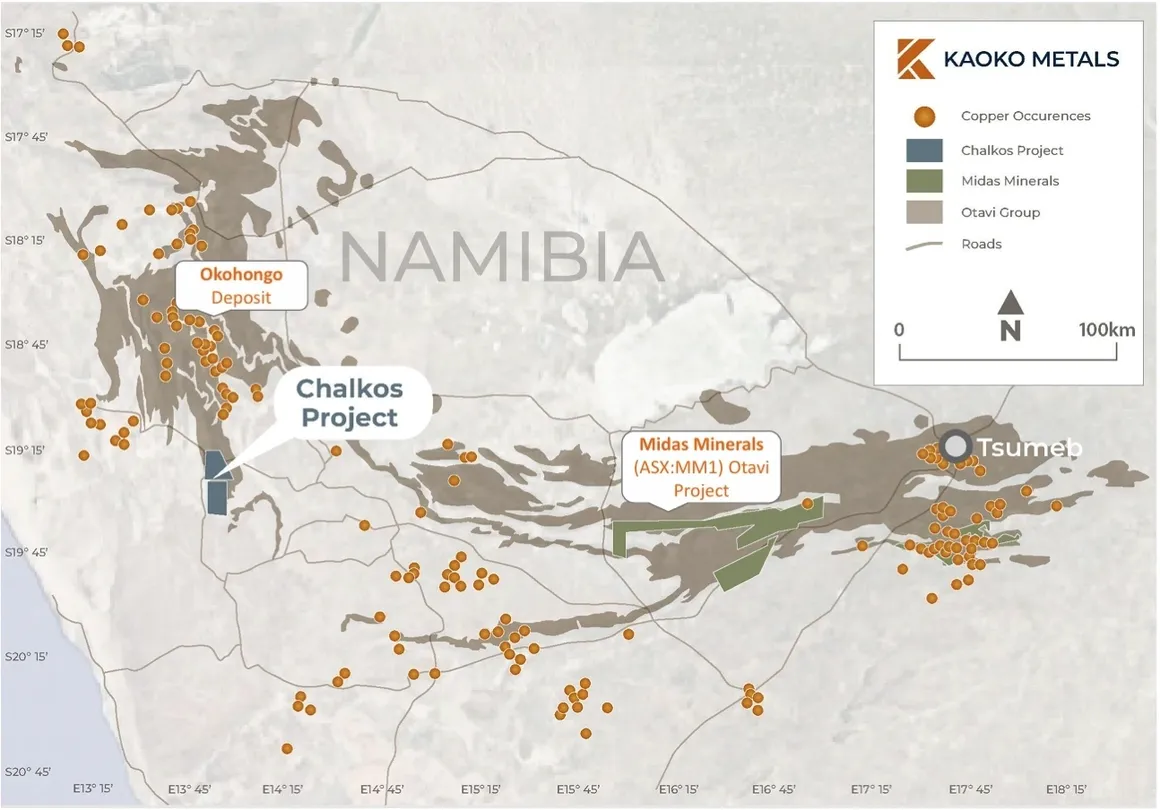
The Kaoko Belt forms the northern arm of the Pan-African Damara Orogen, created by the collision of the Congo and Rio de la Plata cratons roughly 580 to 550 million years ago. The prospective horizon for copper sits in the Eastern Foreland Zone, hosted in Neoproterozoic Otavi and Ombombo Subgroup dolomites and interbedded argillites. This is the same stratigraphy that hosts the historic Tsumeb Mine and the emerging discoveries at Midas Minerals’ Otavi Project.
Tsumeb operated from 1907 to 1996 and produced approximately 30 million tonnes of ore at extraordinary grades – typically cited at 4.3 per cent copper, 10 per cent lead, 3.5 per cent zinc and 95 grams per tonne silver. It yielded roughly 1.7 million tonnes of copper. Tsumeb is not a stratiform deposit – it is a pipe but it demonstrates the scale of metal endowment that the Otavi Group stratigraphy is capable of hosting.
The Tsumeb smelter, now under IXM/Sinomine ownership, historically processed up to 240,000 tonnes of concentrate annually, anchoring in-country downstream capacity.
The nearby Okohongo deposit, drilled by INV Metals and later White Metal Resources, carries an inferred resource of 10.2 million tonnes at 1.12 per cent copper and 17.75 grams per tonne silver, updated in 2021 to 7.7 million tonnes at 1.55 per cent copper and 26.77 grams per tonne silver. That is real copper tonnage in sediment-hosted geology within the Kaoko Belt. It is now controlled by Iron Bull Mining’s Himba Metals subsidiary.
The point I’m trying to make here is straightforward. The geology is known and it works, the endowment is proven. What has been missing is systematic modern exploration across the broader belt. Midas Minerals has now provided the proof of concept that this geological model can deliver high-grade copper-silver discoveries with modern methods.
The Midas re-rate: what happens when you drill this belt
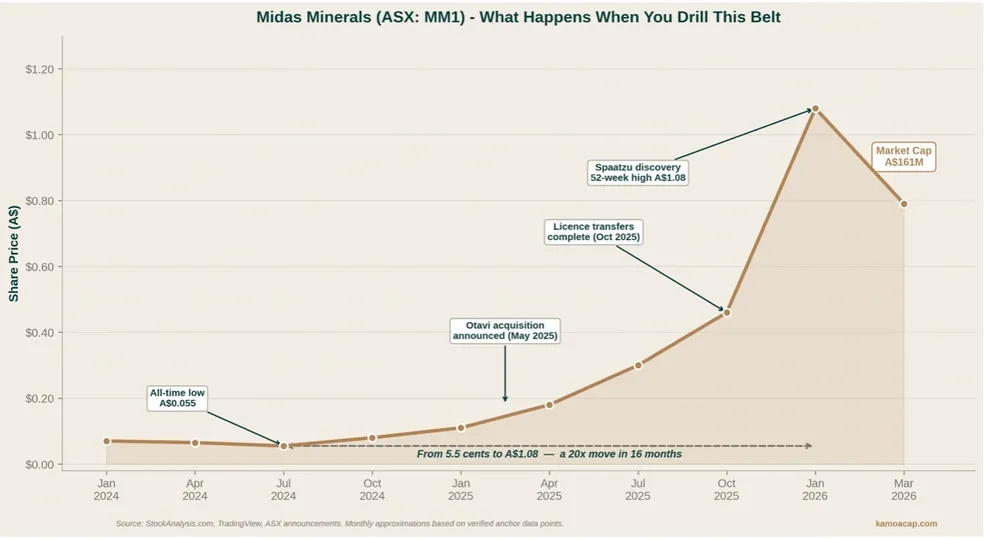
Midas Minerals (ASX: MM1) acquired the 1,776 square kilometre Otavi Project from Nexa Resources in May 2025. Within six months, Midas delivered a near-surface high-grade copper-silver discovery at the Spaatzu Prospect, returning 16 metres at 2.55 per cent copper and 72.6 grams per tonne silver within a broader 44 metre interval at 1.36 per cent copper. Historical drilling at the T-13 deposit had already returned 17.2 metres at 7.24 per cent copper and 144.4 grams per tonne silver including 6 metres at 16.65 per cent copper.
The market responded, from a market cap below A$20 million in late 2024, Midas re-rated to over A$130 million at A$0.64 per share by January 2026. A seven-fold move in twelve months, driven by a single discovery hole and follow-up drilling in the same geological belt.
Kaoko Metals: the adjacent opportunity
Kaoko Metals Ltd (ASX: KAO) listed on the ASX on 07 May 2026, raising A$6.5 million at A$0.20 per share for an implied market cap of A$12 million and an enterprise value of roughly A$5.3 million. It holds two fully permitted, drill-ready projects in Namibia targeting copper, silver, gold and tungsten.
Chalkos Copper-Silver (100% owned)
Chalkos sits in the Kaoko Copper Belt within the Otavi Subgroup, the same geological setting as Tsumeb, Okohongo and Midas Minerals’ Otavi Project. The project covers a confirmed 20 kilometre mineralised strike with an additional 20 kilometres of unexplored prospective trend. Detailed mapping has only been carried out on approximately 700 metres of that 20 kilometre strike. Rock chip samples have returned grades up to 69.6 per cent copper and 2,030 grams per tonne silver at the Donkey Hill and Otniel prospects, with outcropping chalcocite and bornite at surface.
Mineralogy matters. The copper sulphide assemblage – chalcocite, bornite, chalcopyrite, covellite – is highly favourable for processing. Bench-scale acid leach test work on bulk samples from Otniel and Donkey Hill returned copper recoveries of up to 89 per cent from head grades of 7.91 and 10.06 per cent copper.
XRT ore sorting upgraded a 308 kilogram Donkey Hill bulk sample from 9.9 per cent to 13 per cent copper, and an Otniel sample from 3 per cent to 8.5 per cent. That is a dry process requiring no water, with potential DSO implications. Gangue is predominantly quartz and phengite, which are non-acid consuming.
Diamond drilling at Otniel followed by Donkey Hill is planned immediately post-listing.
Karibib Copper-Gold-Tungsten
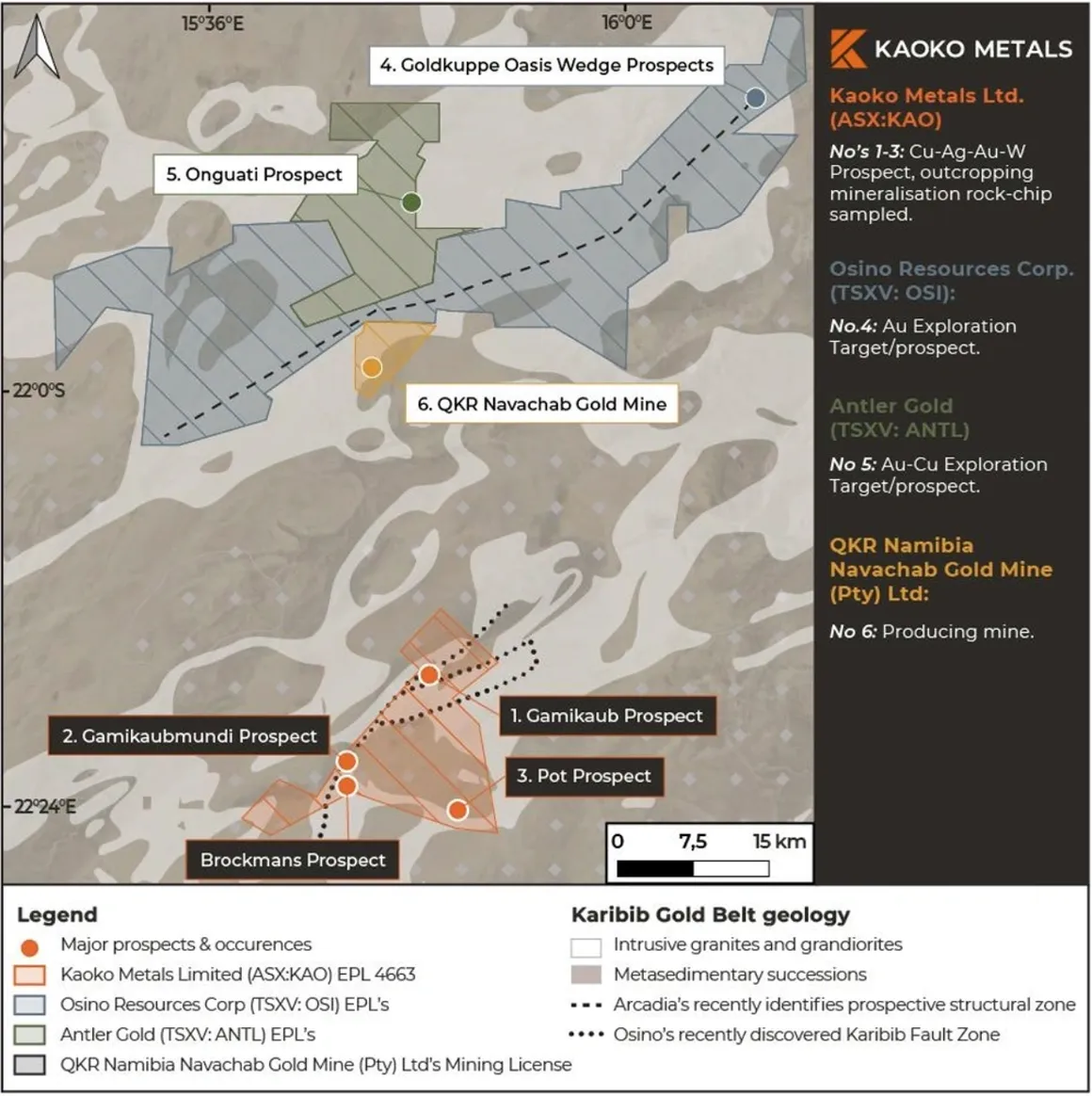
The Karibib Project sits in the Damara Belt, roughly 33 kilometres south of Karibib in the Erongo Region. This is the same structural corridor that hosts the producing Navachab Gold Mine (QKR) and is adjacent to the Twin Hills gold project, which was acquired by Shanjin International for approximately US$272 million at a 44 per cent premium in 2025.
Rock chip sampling at Karibib has returned up to 28.4 per cent copper, 453 grams per tonne silver and 26.3 grams per tonne gold. A 551 metre RC drill programme completed in 2022 under Arcadia Minerals intersected copper-gold mineralisation in eight of ten holes, including 4 metres at 1.98 per cent copper, 0.92 grams per tonne gold and 0.72 per cent tungsten from 9 metres.
The tungsten credit is also worth noting, Karibib includes the Pot’s Mine Prospect, believed to be a historical calc-silicate gold mine with tungsten mineralisation. A large 20 kilometre by 2 kilometre structural corridor sits largely unexplored.
Why Namibia, and why now
Namibia ranked 4th in Africa and 35th globally on the Fraser Institute’s 2024 Investment Attractiveness Index, with the second-best Policy Perception Index on the continent behind Botswana. Exploration spending in Namibia rose 106 per cent in 2024. The country’s Minerals Act provides 25-year mining licences renewable for 15-year terms, with royalties at 3 per cent on base and precious metals and corporate income tax for mining at 37.5 per cent.
The list of global operators tells the story, Rio Tinto at Rossing uranium. B2Gold producing over 200,000 ounces per year at Otjikoto. QKR at Navachab. De Beers offshore. Swakop Uranium at Husab. Shanjin International committing US$272 million to Twin Hills. TotalEnergies calling Namibia its new golden province after the Venus deepwater oil discovery, targeting first oil in 2029 from a 150,000 barrel per day FPSO development.
Walvis Bay handles approximately eight million tonnes of cargo annually with capacity for 750,000 TEU, serving as the deepwater gateway for Botswana, Zambia, Zimbabwe and the DRC via established trans-continental corridors.
Namibia is a functioning democracy with an independent judiciary, a transparent mining cadastre and a track record of honouring licence terms across multiple electoral cycles. For Australian investors accustomed to discounting African jurisdictions reflexively, Namibia warrants a closer look. The infrastructure is real, the operators are tier-one, and the regulatory framework has been tested by decades of continuous production.
The copper deficit is not a forecast – it is arithmetic
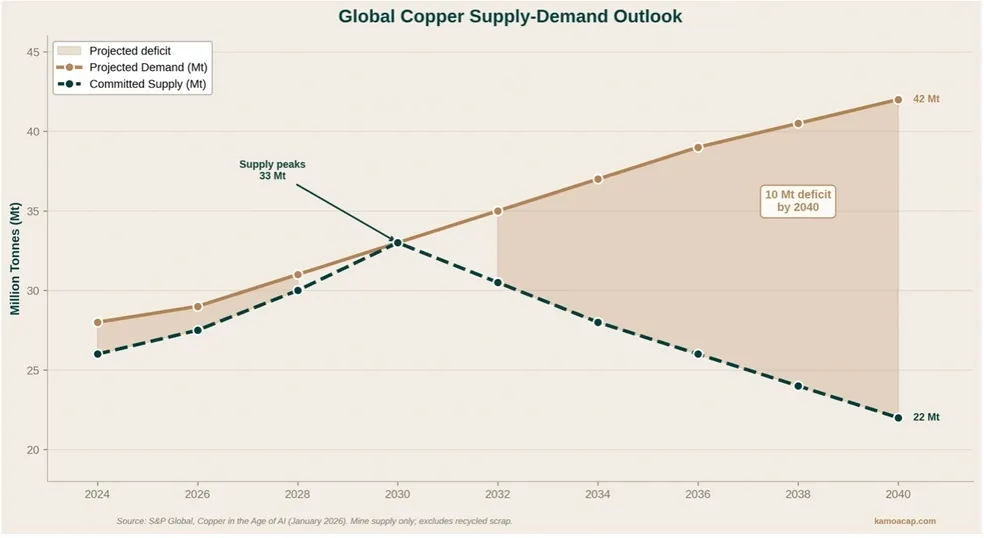
S&P Global published Copper in the Age of AI in January 2026. Demand grows 50 per cent to 42 million tonnes by 2040. Primary mine supply peaks at 33 million tonnes in 2030 and declines to 22 million tonnes by 2040. Recycled scrap doubles to 10 million tonnes and still does not close the gap. The structural deficit reaches 10 million tonnes – 25 per cent below projected demand.
AI data centres alone are forecast to consume 1.1 million tonnes of copper annually by 2030. Defence spending could double to US$6 trillion by 2040, with copper embedded in every platform. Copper was added to the USGS Critical Minerals List in November 2025. Silver – the by-product credit at Chalkos – is in its sixth consecutive year of structural deficit, with cumulative undersupply since 2021 exceeding 820 million ounces.
The response curve is the same everywhere. The average time from copper discovery to first production is 17.9 years globally. Anything that has not been found yet cannot contribute to the 2030 supply equation. But it can contribute to the 2040 equation, and the equity market prices that optionality long before the first tonne ships.
The people
Gerard O’Donovan (Managing Director & CEO).
O’Donovan’s track record speaks for itself. As Executive Director of Sun Silver (ASX: SS1), he helped take a 292 million ounce silver equivalent JORC resource in Nevada from a quiet A$25 million IPO in May 2024 to a peak market capitalisation above A$370 million in less than 18 months. SS1 listed at A$0.20 and hit A$2.19 by December 2025 – a ten-bagger on a company that was priced while silver was still unloved. Before Sun Silver, O’Donovan was Managing Director of Battery Age Minerals (ASX: BM8) and held senior project delivery roles at Pilbara Minerals during the construction of the Pilgangoora Stage 1 lithium plant. He knows how to acquire assets, list them, and drive exploration programmes that generate market attention.
Mark Thompson (Non-Executive Chairman).
Thompson founded Talga Group (ASX: TLG) in 2009 and built it from an A$8 million shell into one of Europe’s most advanced battery anode development companies, with a peak market capitalisation above A$800 million during the 2021 EV materials cycle. Talga’s Vittangi project in northern Sweden holds one of the largest natural graphite deposits in Europe and secured its final environmental permit in early 2025 – a regulatory milestone that took the better part of a decade. His background includes Western Mining Corporation and Sons of Gwalia.
Jody Dahrouge (Non-Executive Director).
Dahrouge is a professional geologist with over 25 years of global exploration experience and the founder of Dahrouge Geological Consulting, a Canadian-based firm that has generated and evaluated early-stage exploration projects across base metals, rare earths and uranium on multiple continents. Critically, Dahrouge was the original vendor of the Corvette lithium property in James Bay, Quebec to Patriot Battery Metals (ASX: PMT / TSX-V: PMET).
Brett Tucker (CFO & Company Secretary).
Tucker is a chartered accountant with more than 20 years of experience advising ASX-listed resource companies through IPOs, reverse takeovers and ongoing corporate compliance. He was previously a Director at Ventnor Capital, a Perth-based corporate advisory firm with deep roots in the junior mining sector.
The look through
What sits inside Kaoko today is a 40 kilometre prospective copper-silver trend in a belt that has produced world-class endowment but has never seen systematic modern exploration. A second project in the Damara Belt gold-copper corridor where Twin Hills just sold for US$272 million. Positive preliminary metallurgy. A board and management team with direct involvement in building Talga Group, Sun Silver and the Patriot Battery Metals Corvette discovery.
The market capitalisation is A$23 million. The enterprise value is A$16.5 million.
Midas Minerals proved what happens when you drill this geological system with modern methods and market it properly. A single discovery hole re-rated the company seven-fold. Kaoko has two drill-ready projects and is mobilising now.
Near-term catalysts
- Maiden diamond drilling at Chalkos (Otniel followed by Donkey Hill), commencing post-listing
- Assay results from Chalkos drilling , expected Q3-Q4 2026
- EM survey at Chalkos to define subsurface targets along the 20 km strike
- Aeromag and LiDAR over both Chalkos and Karibib for structural and geochemical targeting
- RC drilling at Karibib , planned for Q3 2026
- Regional mapping and geochemistry to extend the known mineralised footprint at both projects
What people will overlook
The Kaoko Copper Belt is the same age, same basin type, same structural architecture and same craton margin setting as the Central African Copperbelt. It has a fraction of the exploration coverage. The Tsumeb endowment, the Okohongo resource, and now the Midas Spaatzu discovery prove that the geological system works. A company sitting on 40 kilometres of prospective strike in this belt, with copper outcropping at surface, positive metallurgy, a funded drill programme and an enterprise value of A$5 million is not priced for what it might be.
The copper supply deficit cannot be closed inside a single decade. New mines take 18 years from discovery to production. The world needs every credible belt it can find, and the Kaoko Belt has been sitting in plain sight.
Sources
Kaoko Metals Limited Prospectus dated 23 February 2026 and Investor Presentation dated 7 May 2026; Midas Minerals (ASX: MM1) ASX announcements May 2025 through January 2026; S&P Global, Copper in the Age of AI: The Challenges of Electrification, 8 January 2026; USGS Final 2025 List of Critical Minerals (Federal Register, 7 November 2025); Silver Institute World Silver Survey 2026; Fraser Institute Annual Survey of Mining Companies 2024 and 2025; Hitzman, Selley and Bull (2010), Economic Geology 105(3); Tsumeb Mine: The Jewel of the Otavi Mountains, The Extractor Magazine, 3 October 2025; Namibia Chamber of Mines Fraser Institute commentary; White Metal Resources NI 43-101 Technical Report, Okohongo, August 2021; Arcadia Minerals (ASX: AM7) ASX announcements 2021-2025; Chambers and Partners Mining 2025 – Namibia; ICLG Mining Laws and Regulations 2026 – Namibia; Osino Resources / Shanjin International transaction announcements 2025.
This analysis is from The Drill Down, a daily briefing on critical minerals, junior mining, and capital markets. Join 2,900+ investors and operators who read it before the market opens. Subscribe HERE.
Disclosure
Kamoa Capital has a commercial relationship with Kaoko Metals Ltd. This article is general in nature and does not constitute personal financial advice. Readers should conduct their own due diligence and consult a licensed financial adviser before making any investment decisions. This article contains forward-looking statements based on current expectations and assumptions that are subject to risks and uncertainties. Past performance is not a reliable indicator of future performance.