The Law China Hasn’t Announced Yet
The Law China Hasn’t Announced Yet, and a parallel Chinese mining ecosystem most Western executives can’t see.
This is not mainstream news. You will not find this in the Financial Review, Mining Weekly, or Bloomberg. What follows is drawn from a draft piece of Chinese legislation that has been circulated internally for public comment, in Chinese, unpublicised to the Western world. By the time this is passed and covered by the mainstream press, the window to act on it will have already closed.
A draft law now moving through China’s policy system could reshape global tungsten supply, not gradually, but almost overnight when approved for released.
It is called the People’s Republic of China National Reserve Security Law (人民共和国国家储备安全法). It was prepared jointly by the National Development and Reform Commission and the National Food and Strategic Reserves Administration. It covers all categories of state-designated strategic reserves, grain, energy, and critical minerals, a category that tungsten sits squarely within.
Unlike previous quota cuts, export permits, or dual-use catalogue restrictions, this is not just administrative policy. Once enacted, it becomes permanent national legislation, elevating every tungsten control tool to full legal status, backed by criminal liability.
Here’s what the draft states:
Chinese companies in strategic mineral sectors to hold mandatory buffer inventory reserves that cannot be freely sold or exported. The central government gains explicit power to redirect domestic supply, suspend export contracts, and compel sales into Chinese channels when supply is “significantly short” or prices spike abnormally.
One clause should be read carefully by every foreign mining executive: the draft explicitly prohibits organisations and individuals deemed to have acted against China’s sovereignty or development interests from participating in Chinese mineral procurement, with legal liability extending to Chinese entities outside China’s borders.
Understanding the supply side: why China’s own tungsten is running out
Before this law, there was already a structural problem building quietly inside China’s own resource base.
The average grade of Chinese tungsten raw ore has declined from 0.42% WO₃ in 2004 to just 0.28% in 2024, a 33% deterioration in ore quality over two decades. This is not a cyclical dip. It reflects the systematic depletion of China’s highest-quality deposits after decades of intensive extraction. Lower grades mean higher processing costs, higher energy consumption, and lower recoveries per tonne mined, all of which are part of the factors to be considered whether a mine will be granted any production quota by MNR.
To compensate, China has dramatically ramped up imports of foreign tungsten ore. In 2024, China’s imports of tungsten ores and concentrates surged 114% in volume year-on-year to 12,414 tonnes, of which 30% comes from North Korea. Myanmar alone saw its tungsten exports to China increase by 767% in a single year. China, the world’s dominant producer is now the world’s largest importer of tungsten ore. This is a country quietly securing supply it can no longer reliably produce at home.
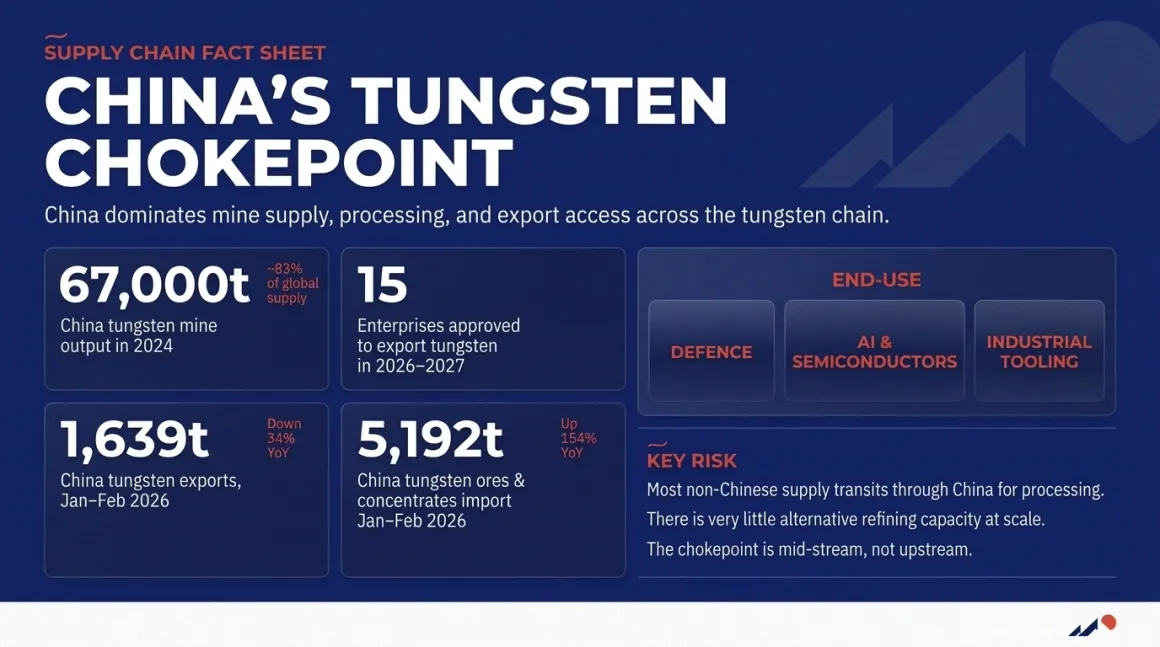
China produces approximately 82.7% of global tungsten output, around 67,000 tonnes in 2024 out of a global total of roughly 81,000 tonnes. Its three primary provinces of Jiangxi, Hunan, and Henan account for 83% of domestic production. The concentration is not just at the mining level, it extends through every downstream processing stage. China dominates APT production, tungsten carbide refining, and finished product manufacturing. When Beijing controls the tap, the entire global supply chain feels it immediately.
This is the kind of analysis we publish daily in The Drill Down.
The Export Problem: only 15 companies can now legally export Chinese tungsten
The supply squeeze described above does not stop at mining quotas and legislation. It is being enforced at the export gate with a precision that most Western analysts have not fully registered.
On 26 December 2025, China’s Ministry of Commerce issued Document 商贸函〔2025〕696号, 钨、锑、白银出口国营贸易企业名单, a complete list of companies authorised to export tungsten, antimony and silver for 2026 and 2027. Of which only 15 companies in all of China are now legally permitted to export tungsten products. Here’s what most people don’t talk about. Even with the permit, each order is being assessed individually by the government which has a processing time of 1 to 2 months.
This is China’s highest tier of export control. It is not a licensing regime where any qualified applicant may apply. There’s a very strict conditions that have to be met before any consideration is given. It is a state-designated whitelist. Companies are approved first, products second. There is no external application path for firms not already on the list.
The result was immediate and severe. From January to February 2026, China’s exports of tungsten products fell 34% year-on-year by volume, totalling just 1,639 tonnes. The most restricted intermediate products collapsed almost entirely: APT exports dropped to zero.
On top of that, Ministry of Commerce issued an updated version of 两用物项和技术进出口许可证管理目录 (Catalogue for the Management of Import and Export Licenses for Dual-Use Items and Technologies), expanded to include more rare earths into much refined classifications. For the case of Tungsten, this effectively widens the regulatory perimeter and the number of tungsten product categories subject to export licensing requirements.
Just 6 days later, China imposed export ban using this specific provision to Japan in response of Japan’s comment on Taiwan’s remarks. My personal view is that China has leveraged this opportunity to use Japan as a sacrificial lamb to choke US’s critical minerals supplies.
What this means for any company currently relying on Chinese tungsten supply is straightforward: the commercial relationship they had in 2023 or 2024 no longer exists in the same form. Supply is now gated by government approval, allocated through fifteen designated intermediaries, subject to individual transaction review, and shaped by geopolitical considerations that no commercial contract can override.
An event that is happening on the other side of the world.
The Iran conflict has depleted Western munitions stockpiles at an alarming rate, according to defence planners. Tungsten is not incidental to this, it is a structural problem. Tungsten carbide is the material of choice for penetrator warheads, armour-piercing rounds, and high-velocity munitions. US operations in Iran are actively depleting munitions reliant on tungsten that cannot be immediately replenished. The majority of global processing capacity to turn tungsten ore into weapons-grade material remains in China. Even non-Chinese supply chains often pass through China first.
A demand story that most tungsten analysts still under-price.
The AI infrastructure buildout is quietly a tungsten story. Every GPU requires a PCB. Every high-density PCB requires hundreds of precision holes drilled by tungsten carbide bits. No commercially viable substitute exists at the tolerances demanded by AI chip manufacturing.
Assuming a flat growth in AI (which we all isn’t true), the estimated PCB bits consumption will jump by 5 to 9x. More layers are squeezed into the same form factor and increased material hardness in PCBs causing the bits’ useful life to decrease substantially. You can read a piece I covered here on X.
Even ASML’s EUV lithography systems rely on tungsten components in light generation and focusing assemblies.
Every new data centre, GPU cluster, and chip fab adds incremental tungsten demand, compounding beneath the louder battery metals narrative.
What does this mean for investors and tungsten project owners?
When this draft law is enacted, it will trigger massive overnight demand for tungsten within China while simultaneously allowing China to tighten export controls at will. This combination is likely to cause severe disruption to international Tungsten supply. Between now and then, it presents a powerful window of opportunity: Chinese that have both the urgency and the capital to fund and secure reliable long-term supply outside of China that’s more immune to political mandates. They bring money, processing expertise and construction capability. You bring the project that needs funding to reach production. The interests align perfectly, if you approach the right parties in the right way.
Why are most approaching China the wrong way?
When an ASX company eyes China for offtake, the instinct is to target the familiar names: Zijin, CMOC, or other household brands. It feels safe and looks good in an announcement. But many need a reality check: (unless your project offers genuine one-of-a-kind scale or strategic value, these majors rarely engage deeply.) They already have full pipelines, strict mandates, and internal hurdles. Most ASX juniors and mid-tiers fall short, turning the signed MoU into the ceiling, not the starting point. More often than not, the MoU falls apart eventually.
What most Western executives miss is China’s parallel mining ecosystem: companies often owned by deeply connected individuals or entities operating behind corporate veils. These companies normally have no online details and sometimes a generic website is possibly the furthest you can get. These are not household names in the West, yet they carry powerful backing and direct links into China’s inner circles.
These firms bring more than capital, offering access to state-owned resources, construction groups to build the mine, metallurgical plants to process ore run by professors who have studied the ores for decades. Crucially, they understand how policy will evolve because they sit close enough to see shifts coming.
They are often hidden in plain sight and very easy to miss.
They are actively scouting overseas projects and think in five-year planning cycles, aligned with Party priorities. They seek long-term partners, not quick offtakes, one that have genuine intention to build a mine in exchange for diversified, policy-resistant supply. To them, the quality of the people matters as much as ore grade.
This is simply not a transaction. It is a 关系 (relationship), built on trust, developed face-to-face over time.
When the trust is built, you’ll know information that cannot be found online.
The executives who want to secure a durable Chinese partnership must invest time identifying counterparties with genuine mandates, policy connections, and long-term commitment. This cannot be done via email. It demands physical presence in China, repeated engagements, and the credibility that comes only from Chinese-style business dinners where real conversations happen. As the saying goes: 感情深,一口闷, when the bond is deep, drain the cup filled with Baijiu in one sip.
That on-the-ground intelligence doesn’t live in public databases. It comes from sustained relationships that have high level of trust and knowing whom to ask the right questions.
China’s mining sector has always been driven by central government policy. That won’t change. What is changing is the legal permanence and enforcement muscle behind it. Executives who grasp this shift early will gain first-mover advantage, access to capital, processing capacity, and partnerships that competitors will struggle for years to replicate.
The window is open and it is not wide, it will not stay open forever.
This report was prepared by Sinamin Consulting in collaboration with Kamoa Capital. We work with mining companies to identify, qualify, and engage the right Chinese counterparties, not the obvious names, but the ones with genuine mandates, and the capability to taking your project to development.
www.sinaminconsulting.com | X @SinaMin_CN
This analysis is from The Drill Down, a daily briefing on critical minerals, junior mining, and capital markets. Join 2,500+ investors and operators who read it before the market opens.