Antimony: The Defence Metal Beijing Controls and America Cannot Make
Antimony has no substitute in the applications that matter most to a country at war.
Primers in roughly 30 per cent of US military ammunition depend on antimony sulphide, per the US Army Joint Program Executive Office for Armaments and Ammunition. Armour-piercing rounds, tracer ammunition, night vision optics, infrared sensors, tritium production, hardened alloys for warheads and tank plating: every one routes back to the same metalloid.
Fastmarkets’ 2026 outlook really highlighted this, there is no one to one alternative for antimony-based flame retardants, and no mature, cost-effective replacement for sodium antimonate as a glass clarifier in solar photovoltaic manufacturing. The United States consumes roughly 45,000 tonnes a year and It mines none of it.
The supply crisis Beijing engineered
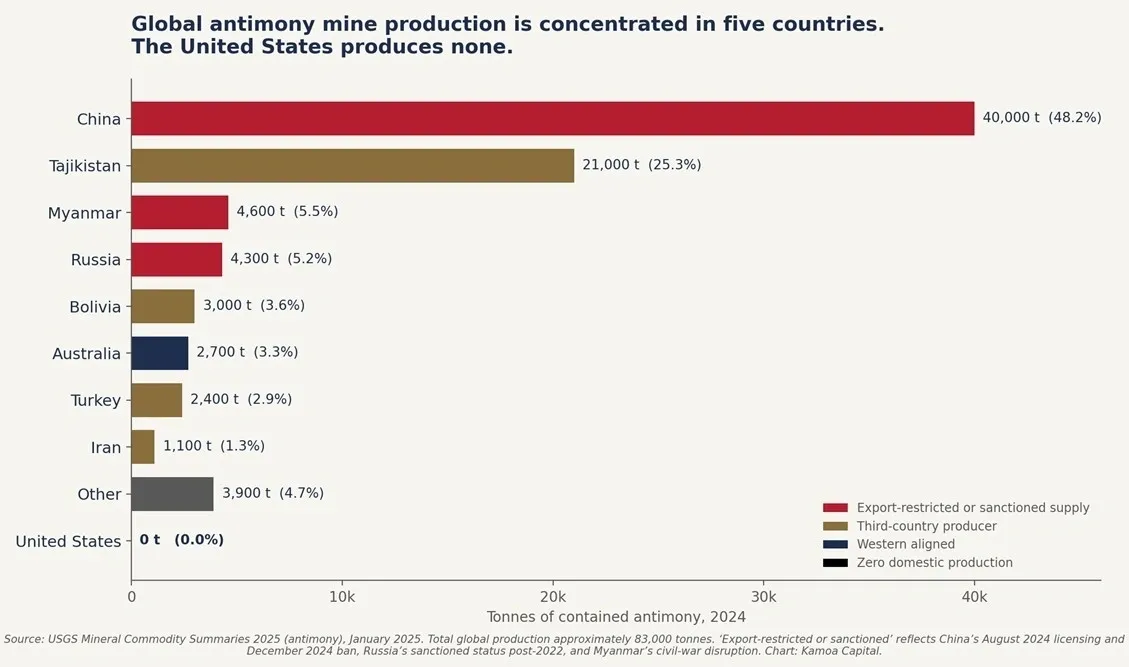
Global mined supply in 2024 was about 83,000 tonnes, per USGS. Five countries produce essentially all of it: China, Tajikistan, Russia, Myanmar, Bolivia. China dominates refining with roughly 80 per cent of the world’s trioxide capacity, even as its share of mining has slipped from a historic 80-plus per cent to around 48 per cent. That slide is not strategy. It is depletion, Hunan environmental inspections, and rising costs. The market has run in structural deficit since 2021.
Then the politics arrived. On 15 August 2024, Beijing announced dual-use export licensing on antimony metal, trioxide and ore. On 3 December 2024, MOFCOM Announcement 46 went further with a principled ban on exports of gallium, germanium, antimony and superhard materials to US end users, plus a blanket prohibition on any dual-use shipments destined for US military use anywhere in the world. Chinese antimony shipments to the US fell 97 per cent within three months.
Price did what physics says a non-substitutable, non-stockpiled input does when its sole exporter walks away. Rotterdam antimony metal sat at US$13,400 per tonne in April 2024. By year-end it was near US$40,000. Fastmarkets assessed a historical high of US$59,750 per tonne on 4 July 2025. A 345% move in fifteen months, in a metal that had traded in a US$3,000 to US$15,000 band for four decades.
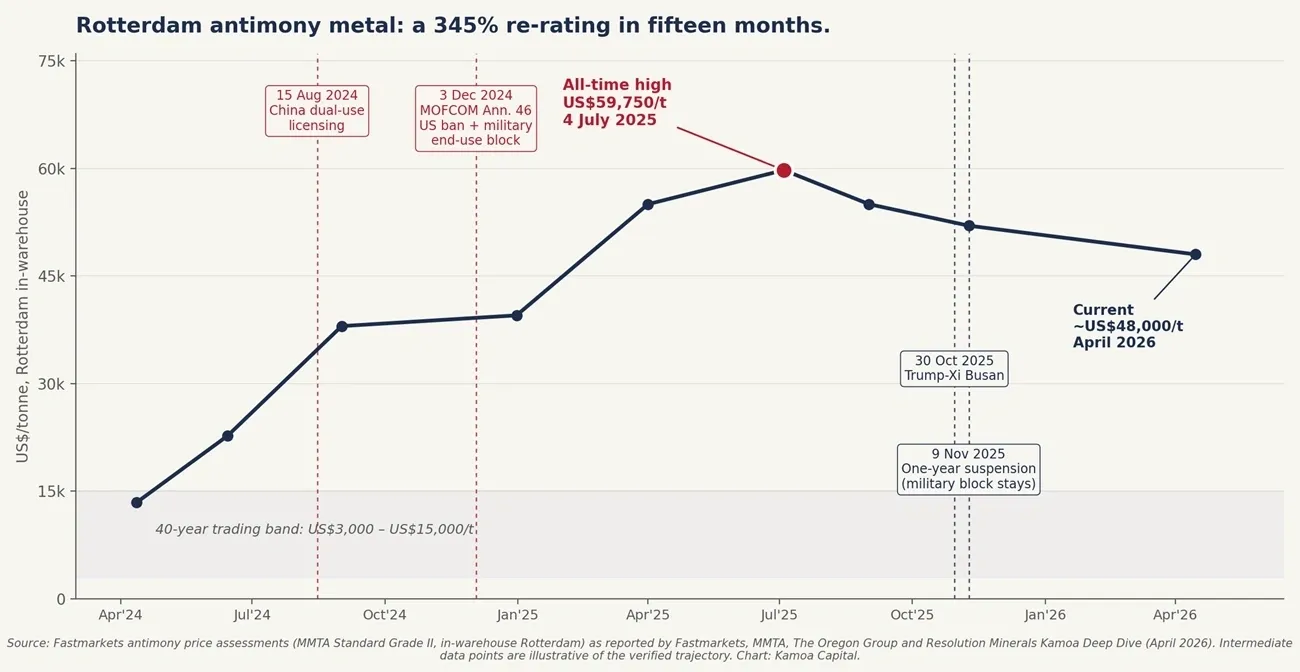
The Trump-Xi meeting at Busan on 30 October 2025 produced a one-year suspension of the December 2024 ban, formalised by MOFCOM on 9 November and running to 27 November 2026. Read the fine print. The military end-use prohibition under Article 1 of Announcement 46 stays in force. Licences still need issuing. Brookings and CSIS both framed the outcome as a tactical pause, not a resolution. The policy architecture is intact. Antimony metal currently trades around US$48,000 per tonne. Still more than three times the pre-control level.
The United States produces zero primary antimony. The last domestic mine closed in 1997. Recycling covers roughly seven per cent of demand. The strategic stockpile was run down decades ago. Antimony is on the USGS critical minerals list. It is embedded in every class of Department of Defense munition, from small arms primers to precision-guided missiles.
Russian output is sanctioned. Volumes from Polyus and other Russian gold producers no longer clear into Western supply chains. Myanmar, the world’s fourth largest producer in 2023 at roughly 4,600 tonnes, is in the fifth year of a civil war that has displaced over three million people and fractured artisanal production out of Shan State. China has also jailed smugglers moving ore across its southern border. Roughly 12% of historical supply has been pulled out of the system.
NATO and allied defence spending hit US$1.51T in 2024, up 7.4 per cent in real terms. Germany committed US$1 trillion to defence and infrastructure, the EU’s ReArm fund totals €800 billion, and China lifted its own defence budget 10.9%. Artillery stockpiles across the West have been drawn down refilling Ukraine and Middle East munitions pipelines. Every round needs a primer. Solar PV glass absorbs roughly 20 per cent of global antimony demand through sodium antimonate, and Chinese PV installations alone added 274 GW in the first eleven months of 2025, matching the full 2024 record. Semiconductor doping, a smaller but faster-growing vector, is being pulled by AI data-centre build-out. Lead-acid batteries are baseline. Ambri’s liquid-metal battery, backed by US federal funding, sits on antimony as a core electrode.
The policy response
Washington has noticed. Executive Order 14241, signed 20 March 2025, invoked emergency mineral authorities and directed every federal permitting agency to identify priority projects for immediate approval. FAST-41, the federal permitting fast-track established in 2015, has been weaponised. 56 critical mineral mining projects have been added, Prior to 2025, FAST-41 was accepting roughly one critical minerals project a year. Six projects have already cleared federal permitting under the accelerated regime, including Perpetua Resources’ Stibnite Gold.
The Pentagon has moved from strategy to cheque. On 22 September 2025, the Defense Logistics Agency awarded United States Antimony Corporation (NYSE American: UAMY) a US$245 million sole-source, five-year IDIQ contract for antimony ingot deliveries into the National Defense Stockpile. It is the first material US antimony procurement in modern memory. UAMY’s first US$10 million delivery order was issued within a week.
The US now needs three things at once: domestic ore, de-risked metallurgy, and permits moving in parallel. Very few companies check all three boxes.
This is the kind of analysis we publish daily in The Drill Down. Subscribe HERE for free.
Resolution Minerals: the adjacent block of the same ore system
Resolution Minerals Ltd (ASX: RML, OTCQB: RLMLF) is the only ASX-listed junior positioned inside the historical heart of American antimony production. Its flagship Horse Heaven project sits in Valley County, central Idaho, approximately 5 kilometres from Perpetua Resources’ Stibnite Gold Project. Stibnite is the fully permitted, approximately US$4.3 billion market-cap Nasdaq-listed (PPTA) gold-antimony developer that US EXIM has notified Congress will receive a proposed US$2.7 billion loan.
During WWII, the broader Stibnite-Yellow Pine district supplied over 90% of total US antimony production to the military effort, per Perpetua’s own feasibility study. Antimony Ridge within Horse Heaven was mined by the US government through WWI, WWII and the Korean War. The geology is the same intrusion-related system. The regulatory jurisdiction is Idaho, tier-one, same Forest Service, same permitting pathway. Horse Heaven is not an analogy to Stibnite. It is the adjacent block of the same ore system.
Federal validation: FAST-41
On 8 April 2026, the US Permitting Council selected Antimony Ridge for FAST-41 Transparency Coverage, in direct response to Executive Order 14241. Resolution is now one of only three ASX-listed companies to receive FAST-41 designation in any form. For a pre-resource junior, this is federal validation at a level rarely seen on the ASX. White House review of the underlying asset, Forest Service engagement, dedicated inter-agency coordination, and a posted federal permitting schedule. Idaho Congressman Russ Fulcher publicly described antimony as vital to US national defence and economic security.
Management has disclosed active engagement with the Department of Defense on potential antimony offtake. Resolution has submitted a Plan of Operations covering bulk sampling and up to 250 drill holes at Antimony Ridge. Brett Lynch, who built Sayona Mining from micro-cap to mid-cap by executing the North American lithium playbook, joined the Board on 17 April 2026 specifically to lead the US expansion. The same federal architecture that moved Stibnite from permits to a US$2.7 billion EXIM notice in under five years is now pointed at Resolution.
The technical moat
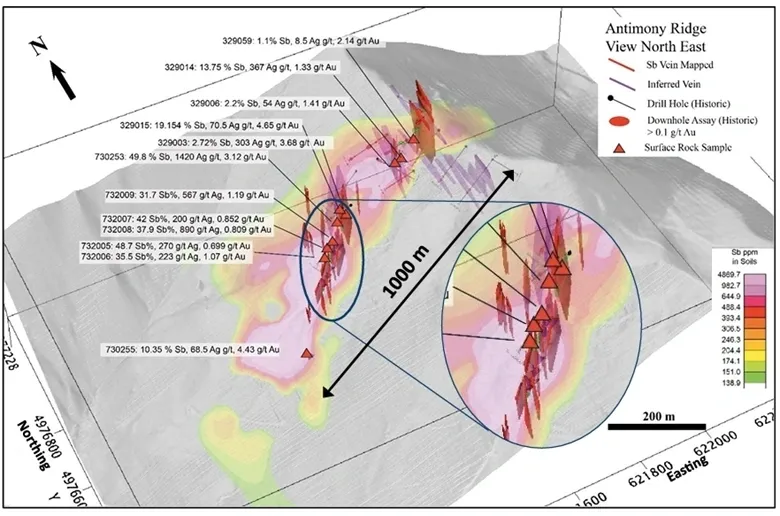
The technical case starts with grade with rock chip sampling at Antimony Ridge returning antimony values consistently above 30% Sb, with peak results of 49.8% Sb, 1,420 g/t silver and 3.12 g/t gold in the same sample. Five large-volume rock samples from historical open pits averaged 39.2% Sb, 430 g/t Ag and 0.92 g/t Au. Most producing antimony operations run at 1 to 3%.
On 10 April 2026, Resolution released 3D modelling defining 30 discrete mineralised vein swarms arranged across a 1,000 metre by 700 metre footprint, 250 metres vertical, all open-ended. Four days later, on 14 April, the company confirmed conventional pyrometallurgy test work at Kingston Process Metallurgy in Ontario had produced an intermediate antimony trioxide product grading 99.38 per cent Sb₂O₃, with low arsenic, iron and sulphur impurities.
Hydrometallurgical test work is running in parallel with concentrate optimisation at IMO Perth. Final refined product results are expected within weeks.
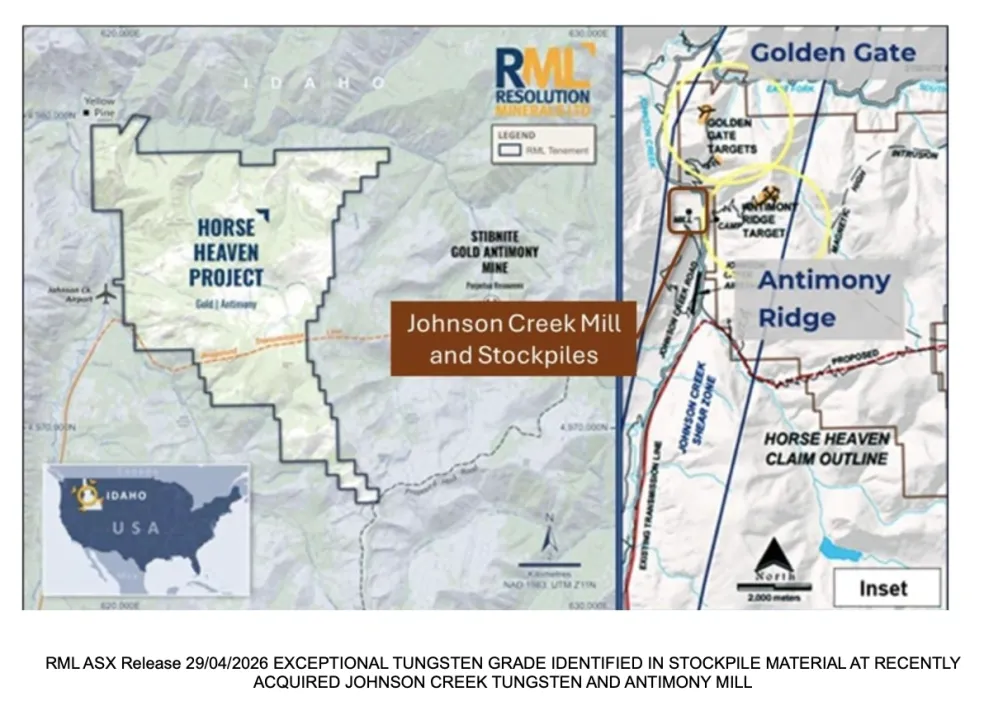
The processing moat extends further. In March 2026 Resolution completed the acquisition of the Johnson Creek Mill, a past-producing tungsten processing facility on ten acres of private land at the base of Antimony Ridge, with on-site power, water, and historical stockpiles averaging 1.85 % WO₃. Managing director Ari Zaetz has flagged it as a fast-track candidate for a US antimony processing hub.
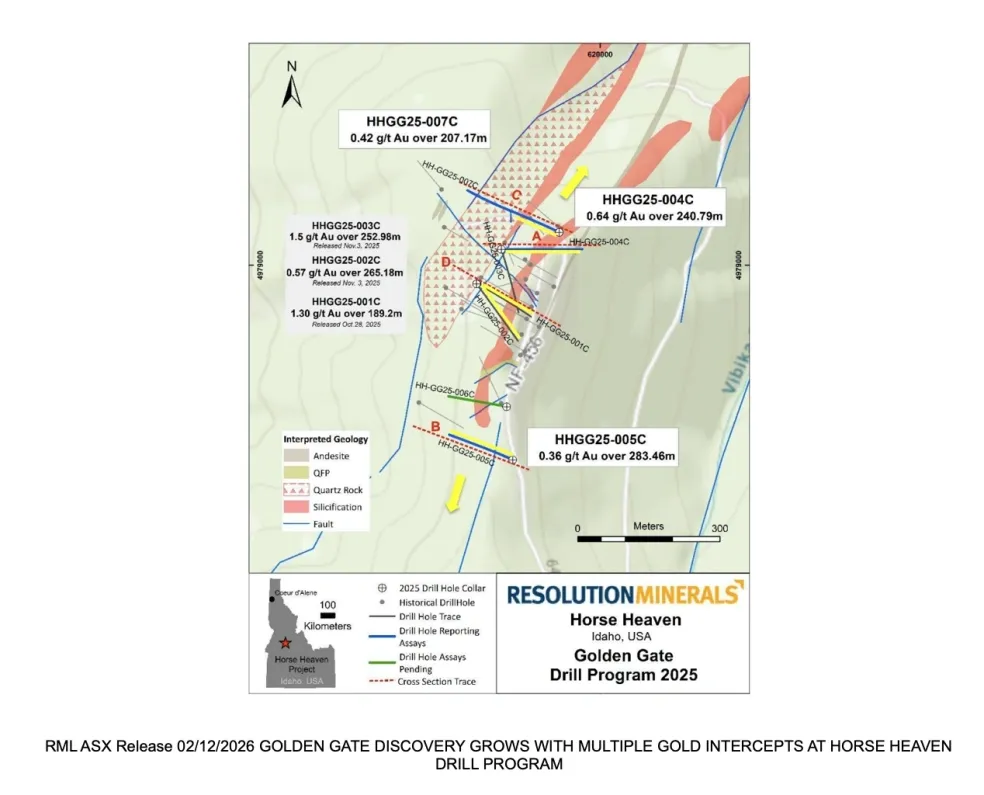
Golden Gate is the optionality layer. Phase 1 drilling returned 253 metres at 1.50 g/t gold from surface (including 111.9 m at 2.31 g/t), 189.2 m at 1.30 g/t from 34 m, and 265.2 m at 0.60 g/t across 1.5 kilometres of strike, every hole ending in mineralisation. Austin Zinsser, who spent twelve years as Perpetua’s senior resource geologist watching Stibnite re-rate from US$50 million to over US$2 billion, now runs the Horse Heaven resource programme.
A Nasdaq dual-listing is targeted for late Q2 2026. Resolution has confidentially submitted a documents to the SEC, with Dominari and Revere as lead managers and Roth Capital as North American adviser.
Near-term catalysts
- Final refined antimony trioxide product results, expected within weeks.
- Plan of Operations approval at Antimony Ridge covering bulk sampling and up to 250 drill holes.
- Commencement of bulk sampling at Antimony Ridge.
- Phase 2 diamond drilling at Golden Gate launches May 2026, up to 13,700 metres (45,000 ft) over approximately 45 holes.
- Nasdaq dual-listing targeted late Q2 2026.
- Maiden JORC Mineral Resource Estimate at Golden Gate targeted Q1 2027.
- DoD offtake engagement and potential DPA Title III funding pathway.
- Near-term tungsten processing revenue optionality from Johnson Creek stockpiles.
The look through
Resolution’s market capitalisation is approximately A$150 million. Perpetua, on the adjacent block of the same ore system, trades at roughly US$3.4 billion. Larvotto Resources, an Australian antimony peer with a 1.7 Moz AuEq DFS, received an A$722 million bid from UAMY.
FAST-41 collapses permitting risk. Johnson Creek collapses processing risk. Antimony Ridge grade collapses feedstock quality risk. Golden Gate stacks gold and tungsten optionality onto the antimony thesis. A Nasdaq dual-listing collapses capital access. A maiden MRE in Q1 2027 collapses resource risk.
The antimony supply problem cannot be solved inside a single US election cycle.
Building a domestic mine from scoping to production takes seven to twelve years in the most expedited jurisdiction on earth. The Busan suspension runs twelve months. The policy architecture that priced antimony to US$59,750 a tonne remains intact.
Sources
USGS Mineral Commodity Summaries 2025 (antimony); Fastmarkets antimony price assessments (MMTA Standard Grade II, in-warehouse Rotterdam) July 2025 and April 2026; MOFCOM Announcement No. 46 December 3, 2024; MOFCOM export licensing notice August 15, 2024; MOFCOM suspension notice November 9, 2025; The White House Executive Order 14241 March 20, 2025; US Federal Permitting Improvement Steering Council FAST-41 dashboard November 2025; US Army JPEO Armaments and Ammunition; Department of Defense / Defense Logistics Agency release September 22, 2025; Brookings Institution commentary November 2025; CSIS commentary November 2025; The Oregon Group April 2025; NATO Secretary General Annual Report 2024; Perpetua Resources 2021 Feasibility Study and SEC/NASDAQ filings; United States Antimony Corporation (NYSE American: UAMY) press releases August 2025 and September 2025; Resolution Minerals Ltd (ASX: RML) announcements March 2, March 26, April 8, April 10, April 14 and April 17, 2026; Resolution Minerals Kamoa Deep Dive April 2026; Investing.com and Morningstar / Yahoo Finance closing prices April 10, 2026.
This analysis is from The Drill Down, a daily briefing on critical minerals, junior mining, and capital markets. Join 2,800+ investors and operators who read it before the market opens. Subscribe HERE.
Disclosure
Kamoa Capital has a commercial relationship with Resolution Minerals Ltd and doesn’t own any equity in the company. This article is general in nature and does not constitute personal financial advice. Readers should conduct their own due diligence and consult a licensed financial adviser before making any investment decisions. This article contains forward-looking statements based on current expectations and assumptions that are subject to risks and uncertainties. Past performance is not a reliable indicator of future performance. All data was verified against authoritative sources at time of publication, including USGS Mineral Commodity Summaries, Fastmarkets, MOFCOM