Copper: The Capability They Cut
Kincora and the return of the majors to greenfield exploration.
There was a time when the major miners did their own greenfield exploration and a greater percentage of total exploration expenditure went into finding the next generation of new major provinces and deposits.
In the early 2000s, AngloGold Ashanti and Gold Fields operated their own teams in the Macquarie Arc in New South Wales, exploring for large gold-rich copper porphyry systems. They secured ground, generated greenfield targets and drilled them. When the commodity cycle turned in 2015 and 2016, those functions were cut, and they were cut across the global industry.
At the time it was an easy place to save money in a very bleak market. Head count was dramatically reduced across the sector and exploration collapsed. The problem is that an exploration team and prospective exploration ground is not something you rebuild simply by approving a new budget. It is years of accumulated geological knowledge, relationships, field experience and judgement about a particular belt.
Once those people disperse, you can hire geologists again. What you cannot easily hire back is the decade of context that disappeared with them, and the project pipeline.
That matters now because copper has moved back to the centre of the mining growth story and the growth options are increasingly bare. The majors have spent the past several years buying producing assets, development projects and brownfield growth. Only recently are some beginning to move back towards greenfield exploration, and many are returning without the internal teams they previously had. Head count and ESG hurdles have become dramatically harder since the last commodity cycle.
What the majors increasingly appear to be doing to rebuild and leverage this function is buying access to that capability through juniors. Capability here includes the ground, the targets, the intellectual capital, the teams, and the ability to deal with ESG and operate. The majors here are not just the traditional diversified or copper majors, but increasingly the gold majors as well, with Barrick no longer being “Barrick Gold” but a major producer of gold and copper.
In the Macquarie Arc, both Gold Fields and AngloGold Ashanti are back, and with bigger portfolios than before. They are on the hunt for the next generation of large discoveries. This time, however, they have outsourced their exploration function.
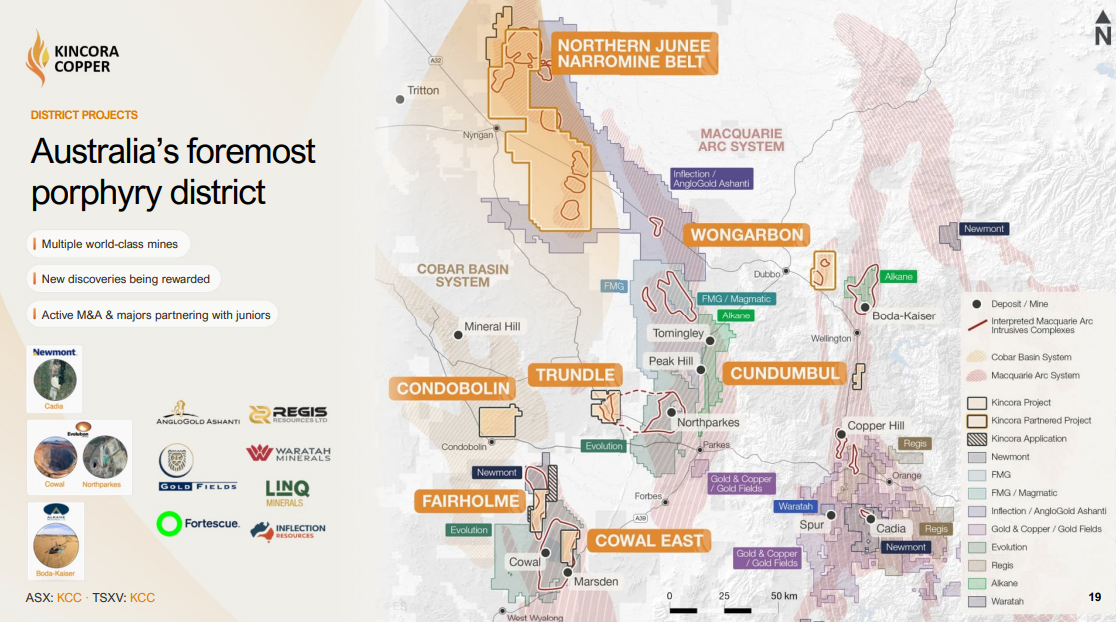
Gold Fields has a series of option and earn-in agreements with a private explorer holding ground around Cadia. AngloGold Ashanti now has two earn-in and joint venture agreements with Kincora Copper over the Northern Junee-Narromine Belt, along with a separate earn-in with Inflection Resources. In these deals the junior is currently the operator.
FMG and Evolution are new into the district this cycle. Newmont has two agreements with Koonenberry Gold, including Junee and Koonenberry’s Fairholme project immediately north of Kincora’s own Fairholme ground. Kincora’s April 2025 disclosure put more than A$385 million of potential earn-in and joint venture capital into the Macquarie Arc from deals done with junior explorers.
That is why I have spent time looking at Kincora Copper and revisiting some of the medium to longer term market dynamics for copper.
Kincora are applying a business model that is not so common in Australia but one that makes sense given the structural trends taking place in the industry. Their business is not simply to own prospective ground, but to generate new geological concepts and the drill-ready targets that the majors increasingly appear willing to pay somebody else to generate. Kincora are doing this with a technical team that are subject matter experts in this district, a portfolio of projects that have attracted majors before, and a pipeline of large-scale targets.
This is the kind of analysis we publish daily in The Drill Down. Subscribe HERE for free.
Copper has the money, greenfield does not
The macro case for more copper is not particularly controversial anymore.
S&P Global’s Copper in the Age of AI, published in January 2026, has demand increasing from 28 million tonnes in 2025 to 42 million tonnes by 2040. Primary mine supply peaks at 33 million tonnes in 2030 before falling to 22 million tonnes by 2040, while scrap supply more than doubles to around 10 million tonnes. Put the two supply sources together and you still end up with roughly 32 million tonnes against 42 million tonnes of demand.
That is the 10 million tonne gap everyone focuses on. That gap is effectively twice the size of the world’s top 10 current copper mines. New provinces and major discoveries are needed.
Forecasts like this should not be treated as gospel and, as we all know, they move, sometimes materially. The International Copper Study Group had 2026 sitting at a 209,000 tonne surplus in April 2025 and a 150,000 tonne deficit by October of the same year. The direction is useful but the exact number is an estimate.
Where the exploration money is actually going tells you more.
Global nonferrous exploration budgets fell 0.6% to US$12.4 billion in 2025, marking the third consecutive annual decline, according to S&P Global’s World Exploration Trends 2026. As stated in the 8 September article by the AFR, The world is hungry for copper, so why aren’t we looking for it?, copper exploration in Australia has slumped 66 per cent in three years, despite prices surging about 75 per cent over that period.
Grassroots exploration fell to a record-low 21% share of global exploration budgets. For copper specifically, S&P’s earlier work put the grassroots share at roughly 28%, compared with 50% to 60% through much of the 1990s and early 2000s. Minesite and near-mine work, meanwhile, reached a record 45% share of expenditure.
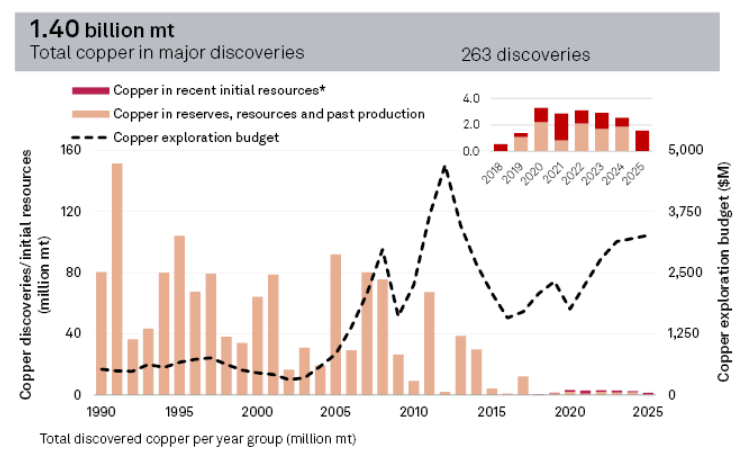
Richard Schodde of MinEx Consulting has put the consequence fairly plainly. Over the past decade, the rate of new copper discoveries has roughly halved alongside a 60% decline in grassroots funding. Between 2010 and 2024, exploration around existing mines and advanced projects added around four times as much copper as greenfield discovery did.
As the AFR article supports, Australia shows much the same pattern.
So there is less money available for copper exploration, there is much less willingness to spend the money available on grassroots work, and the money does not go as far as it used to in terms of metres in the ground given cost inflation. With these factors it is not surprising to see discovery rates decreasing and the copper pipeline increasingly bare.
S&P’s cohort of mines entering production between 2020 and 2023 took an average 17.9 years from discovery to first production, compared with 12.7 years for projects entering production between 2005 and 2009.
Anything expected to materially help the copper market in 2040 needed finding some time ago.
Why the Macquarie Arc matters
New South Wales hosts Australia’s foremost porphyry copper district. Porphyry deposits supply over 60% of the world’s primary copper. They are large, capital and time intensive, a combination that often makes them challenging for those relying on funding from the public markets.
The Macquarie Arc contains Cadia and Northparkes and carries a total inventory of more than 160 Moz gold equivalent. It has also produced two discoveries above 10 Moz gold equivalent during the current exploration cycle.
Despite that geological endowment, capital invested has not treated the district like some of its international equivalents. We wonder, is it the rocks, the jurisdiction, or the method sought to access capital?
Kincora’s comparison between the Macquarie Arc and British Columbia’s Golden Triangle puts the cumulative market capitalisation of Golden Triangle porphyry explorers and developers above $2 billion, compared with less than $500 million across the Macquarie Arc. The geological argument for New South Wales is not difficult to make. The district has world-class operating mines, a larger metal endowment, an exploration and mining culture, established infrastructure, a year-round field season, lower operating costs and a long history of producing large porphyry systems. The size of the two mineral districts and jurisdictional risk are both comparable.
What it has not had is anything close to the capital that has followed the Golden Triangle. It is worth noting that a considerable amount of that capital for the Golden Triangle is increasingly from partnerships between the majors and junior explorers and developers. The prospect generator model, partner and seek to sell to a major, is far more common in North America.
That gap helps explain why the earn-in model matters here. If domestic equity markets are not willing to fund systematic greenfield exploration at the scale required, or at an acceptable cost of capital, which is particularly significant given the nature of large porphyry copper systems, then partner capital becomes not only the practical alternative but probably the most pragmatic means to generate shareholder value. Kincora’s model looks less like a corporate preference when viewed through that lens and more like a response to how exploration is actually funded on a global scale in the current market.
What Kincora actually is
Kincora Copper Limited is dual-listed on the ASX and TSXV under KCC.
At A$1.07, the company has a market capitalisation of approximately A$55 million, with 48,017,386 shares and CDIs on issue, as at September 18, 2026. It held approximately A$12 million in cash at mid-August 2026, with a further US$5 million due from the divestment of its Mongolian projects, US$1.5 million of which has since been received.
The business is best described as a hybrid prospect generator.
Partners fund the majority of exploration expenditure. Kincora secures the ground, conducts the early work required to generate and rank targets, operates the exploration programmes and often charges a 10% management fee on partner expenditure.
The company reports six asset-level partnerships unlocking more than A$100 million of potential multi-year partner funding, with more than US$10 million of partner-funded exploration and over 20,000 metres of drilling completed since late 2024.
The current flagship example of this is the Northern Junee-Narromine Belt project, covering 2,359 square kilometres over more than 100 kilometres of strike. It sits under two AngloGold Ashanti earn-in and joint venture agreements. This region is thought to be the under-cover extension of the Macquarie Arc. Kincora and AngloGold Ashanti are exploring for a new province, true greenfield exploration, at a scale of twice the strike of the Vicuña porphyry belt.
Vicuña is an extension of the central Andean belts in Argentina, on the border of Chile and situated at over 4,000 metres altitude. Within this district, NGEx Resources Inc in 2009 held three early-stage exploration projects and at the time had a market capitalisation of approximately C$40 million. These same projects were financially supported by the Lundin family, are all still at a pre-development phase, but have yielded four large-scale discoveries valued at over A$15 billion.
Kincora also owns the Fairholme, Cowal East, Trundle, Cundumbul, Condobolin and Nyngan West projects outright, has a partnership with Fleet Space for the Wongarbon project, and earlier in the year executed a definitive agreement for a staged cash sale of its Mongolian projects for a total of US$10 million. More partnerships are a priority.
The balance sheet changes the model
The prospect generator funding model generally sees dilution not at the listed company level but at the project level, and only upon success when the partner satisfies milestones needed to earn the project level interest.
This supports prospect generators having the ability to explore more projects simultaneously, having more shots on goal.
Understandably, these partners generally undertake extensive technical due diligence before investing and often provide ongoing technical assistance going forward, with the major miners having in-house technical teams the junior does not.
Following extensive recent independent, internal and next-generation technical reviews, Kincora has identified and advanced a unique pipeline of large-scale epithermal gold and porphyry copper targets, and commenced a formal process seeking new potential asset-level partners for three wholly owned projects: Fairholme, Cowal East and Trundle. These projects are all situated within camps hosting greater than 20-million-ounce gold equivalent resource inventory. All have previously attracted major mining companies.
Kincora had approximately A$12 million of cash by mid-August 2026. Since then, a further US$1.5 million was received for the divestment of its Mongolian assets, with another US$3.5 million expected before year end.
The company has recently stated a sole-funded exploration programme of over 25,000 metres of shallow air-core drilling, budgeted at up to A$3 million over the Spring-Summer field season. This programme is designed to expeditiously and cost effectively advance geological concepts and add scale across four projects and 17 targets. Kincora are also expecting this to complement and enhance the value equation of ongoing asset-level partner discussions.
Trailing operating cash outflow is running at roughly A$5 million annually on an indicative basis. Against approximately A$14 million in cash, further Mongolian proceeds still to come, AngloGold funding drilling on partnered ground and management-fee income flowing from partner expenditure, Kincora appears well funded through the catalysts currently on its schedule.
That is more important than it first appears.
For an explorer with a market capitalisation below A$55 million, funding changes negotiating leverage. A company that does not need to sign a deal this quarter can negotiate partner terms very differently from one approaching the end of its cash runway.
It also reduces a couple of the biggest risks in junior exploration. The first is dilution, with no likely need for further equity capital for the foreseeable future. The second is portfolio risk and return profile, with a unique number of potential value catalysts from further material new partnerships, new projects and drilling. Over the last 12 months, and including the upcoming six-month horizon, a minimum of 12 licences are expected to be drilled.
What is actually being drilled
The Northern Junee-Narromine Belt project is currently the largest strategic position in the portfolio. The southern Macquarie Arc hosts Cadia, Northparkes, Cowal and Boda-Kaiser. The northern extension is interpreted as the same arc beneath post-mineral cover, yet no significant deposit has been discovered there to date. That is the geological thesis AngloGold Ashanti is paying to test.
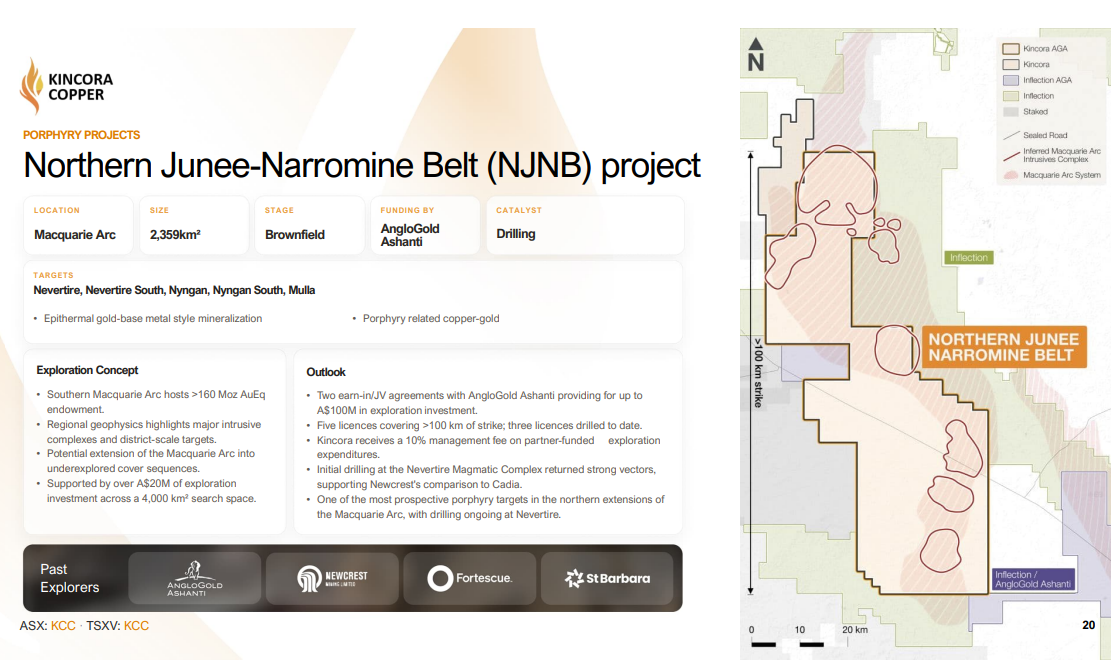
Five licences make up the package, three of which have been drilled so far. Across those three, 43 holes for 17,620 metres have been completed with AngloGold. Initial drilling at the Nevertire Magmatic Complex returned geological vectors that Newcrest had previously compared with Cadia. Drilling is continuing at Nevertire at AngloGold’s expense, with Kincora earning management fee income. An exploration update is expected shortly.
Condobolin is different because it is the one asset where Kincora is spending its own money on a direct discovery attempt rather than primarily generating targets for partners.
Why? Because this is not a porphyry project. It is a Cobar style deposit and a historical mining field that Kincora has consolidated. The time and capital profile are such that Kincora thinks a junior can relatively quickly and cheaply add value, noting a third-party mill within trucking distance is seeking ore.
The Meritilga discovery returned 4 metres at 20 g/t gold and 30.2 g/t silver from 75 metres, including 1 metre at 62 g/t gold and 60 g/t silver.
A nine-hole, 2,615 metre diamond programme was completed in 2026 and assays remain pending. It is the first systematic drilling of the field in more than a decade, seeking to better understand the nature of the mineral system, whether it is a reduced intrusion system, the size of the system, and whether prior high-grade hits have continuity.
Then there are the four air-core programmes.
Kincora plans to spend up to A$3 million on around 340 holes and more than 25,000 metres across 17 targets at Nyngan West, Fairholme, Cowal East and Trundle. That works out at roughly 74 metres per hole, which tells you what these programmes are actually trying to do.
This is not deep or expensive discovery drilling. That is left for the partners. It is shallow basement sampling beneath cover, designed to map geochemistry, alteration and lithology and work out which targets justify deeper drilling.
That distinction matters because this is essentially the product Kincora is selling.
The company takes a large piece of prospective ground, does enough technical work to reduce the geological uncertainty, confirm its thesis and increase the scale of the targets, then tries to turn those targets into something a larger partner will fund.
At Nyngan West, the licence covers 207.4 square kilometres with no outcrop and has never previously been drill tested or basement sampled. Two porphyry targets sit over the Junee-Narromine Belt under shallow cover, noting Kincora is currently drilling on the adjacent licence with AngloGold Ashanti. There is also a separate magnetic high and gravity low which has been interpreted as Fifield Suite, prospective for scandium, nickel and cobalt.
At Fairholme, Kincora’s prior air-core and diamond work has extended the Gateway gold and base-metal system from 600 metres to 1,600 metres of strike, with the next programme seeking to add another kilometre. This target is analogous to the neighbouring gold corridor at Cowal, which now has a 15 Moz gold endowment and is Evolution Mining’s flagship asset. Five other earlier stage targets are also to be drilled by Kincora.
Kincora’s Cowal East project sits immediately to the east, on the other side of Lake Cowal to the Cowal mine and as close as 4 km north of the Marsden porphyry copper-gold deposit. Six early-stage prospects are to be drilled, testing similar targets and settings to those that led to the discovery of Marsden, which Kincora’s technical director John Holliday oversaw for Newcrest.
The Trundle project is interpreted to host the western rift of the Northparkes Igneous Complex, which to the east hosts nine economic deposits, a 24 Moz gold equivalent mineral endowment and Australia’s second largest copper porphyry mine. Very shallow drilling across a total 19 square kilometre area is seeking to replicate the success of similar programmes at the Northparkes mine.
The people matter more in this model
In most junior mining companies, management biographies sit somewhere near the back of the presentation. Here I think they matter more.
The product Kincora is selling is geological judgement and the ability to execute.
John Holliday has been a non-executive director since 2017 and chairs the technical committee. He originated and led the discovery phases of Cadia and, with his Newcrest team, Marsden. Cadia ultimately became a Tier 1 operation, and Holliday lives in the district.
In a company whose business is generating porphyry targets in one geological belt, that background matters more than most director biographies.
Peter Leaman, VP Exploration, is the other heavyweight on the Kincora technical committee, bringing previous exploration experience from BHP and PanAust. Peter is also credited with a Tier 1 copper-gold discovery, Reko Diq.
Sam Spring has been President and CEO since 2013. He was previously a mining analyst at Goldman Sachs and Ocean Equities, is a CFA and former chartered accountant, and has overseen Kincora’s transition towards the current prospect-generator model, six asset-level partnerships and the US$10 million Mongolian divestment.
Cameron McRae has chaired the company since August 2018 and previously held senior roles with Rio Tinto and Oyu Tolgoi.
The board and management own over a quarter of the company, supporting skin in the game alignment.
What comes next
There are many catalysts over the next few months, many more than most juniors.
A drilling update from activities with AngloGold Ashanti at the Northern Junee-Narromine Belt project is shortly expected, with guidance on both immediate targets and wider district scale activities. The key here is not looking for immediate economic intervals but confirmation of the geological thesis and whether exploration expenditure is increasing.
Condobolin has assays pending from the nine-hole diamond programme. Nyngan West air-core drilling is expected to be completed before year end. An Atomionics quantum gravity survey at Cowal East is scheduled to commence in November 2026. Fairholme air-core drilling is expected to begin immediately after the Christmas-New Year break, then rolling into Cowal East and Trundle.
The company also has the formal asset-level partnership process underway across Fairholme, Cowal East, Trundle and Cundumbul, although no completion date has been provided.
Final proceeds from the Mongolian divestment are also due.
Kincora is also looking at other opportunities, new ground or existing projects, where it feels it has a competitive advantage to add value pursuing its hybrid prospect generator model.
None of these on its own necessarily changes the company.
Together they make the next six months fairly important.
The Condobolin results test the only meaningful sole-funded discovery programme. The air-core drilling tests whether Kincora can generate another generation of partner-ready targets, increasing scale and upgrading its geological concepts. The partnership process tests whether there is genuine third-party demand for those projects on acceptable terms. AngloGold Ashanti’s continued expenditure tests whether the major still likes what it sees in the Northern Junee-Narromine Belt.
They are different catalysts, but they are all really testing the same business model.
Where I land
Kincora is a bet on something different from the usual junior exploration story on the ASX, or most junior equities offering copper exposure. It is not simply a bet that one particular drill hole or programme works. It does not have the dilution risk the exploration and development sector traditionally faces, particularly when hunting what would be a globally significant new copper discovery if successful.
It is a bet on a portfolio of projects and execution of a business model, that major miners continue buying access to greenfield exploration capability through juniors rather than rebuilding the internal teams they dismantled, and that Kincora remains one of the companies they choose to work with.
AngloGold has already signed two agreements and is drilling. Newmont is doing something similar next door with another junior. Three projects currently being marketed for partnership sit next to world-class mines and have attracted major miners in previous commodity cycles. That is enough to establish that the model exists.
Kincora’s growing cash position, on track to increase each quarter of 2026, and partner-funded exploration and management fee income provide significant runway for it to continue advancing this model, increasing scale and systematically exploring while reducing risk, and pursuing additional opportunities where it has a competitive advantage.
The appeal of this funding model is complemented by a tight share structure with only 48 million shares outstanding, split almost equally across both the TSXV and ASX, with over 25% of the company represented on the board by reporting insiders.
There are two things I would watch most closely in the near to medium term.
The first is whether Fairholme, Cowal East or Trundle converts into another signed partnership. That would tell me there is genuine demand for the product Kincora is trying to create, and the company may then become self-funding, with management fee income covering corporate costs.
The second is what AngloGold Ashanti does at Nevertire.
Continued expenditure or an increase in exploration budgets tells you the immediate targets and larger thesis remain intact, if not upgraded.
A slowdown in activities or withdrawal without another partner stepping in would tell you something very different.
This analysis is from The Drill Down, a daily briefing on critical minerals, junior mining, and capital markets. Join 3,300+ investors and operators who read it before the market opens. Subscribe HERE.
Sources
AFR, The world is hungry for copper, so why aren’t we looking for it?, 8 September 2026; S&P Global Market Intelligence, Copper in the Age of AI: The Challenges of Electrification, 8 January 2026; S&P Global Market Intelligence, World Exploration Trends 2026, March 2026; S&P Global Market Intelligence mine development times analysis, 2024; International Copper Study Group forecasts, April 2025 and October 2025; Richard Schodde, MinEx Consulting, copper discovery-rate and grassroots-funding analysis.
Kincora Copper, Exploration Strategy Update: Drilling Planned Across Four Projects, 3 September 2026; Kincora Copper 2026 Q2 Financials Package, 14 August 2026; Kincora Copper 2026 Q1 Financials Package, 14 May 2026; Kincora Copper FY2025 Annual Report and MD&A, 30 March 2026; Kincora Copper ASX announcement, 17 April 2025; Kincora Copper Investor Presentation, 9 July 2026; Blue Ocean Equities initiation research on Waratah Minerals, 8 October 2024; Pulse Intelligence company and market data; Kincora Mongolian divestment and proceeds disclosures; Australian copper exploration expenditure data.
Disclosure
Kamoa Capital has a commercial relationship with Kincora Copper Limited. This article is general in nature and does not constitute personal financial advice. Readers should conduct their own due diligence and consult a licensed financial adviser before making any investment decisions. This article contains forward-looking statements based on current expectations and assumptions that are subject to risks and uncertainties. Past performance is not a reliable indicator of future performance. Historical exploration results referred to in this article, including previous operators across Kincora’s NSW projects, are historical third-party data. Kincora has not independently verified this information and a Competent Person has not done sufficient work to classify it in accordance with the JORC Code (2012). It is uncertain that further exploration will result in the determination of Mineral Resources. A geophysical anomaly is not a Mineral Resource and there is no certainty that drilling will define mineralisation.